
Table of contents
Research and Custom Environments Beyond EduNet and WorkNet
When people first encounter IntentNet, they often focus on its most visible implementations.
EduNet.
WorkNet.
That reaction is understandable.
These environments are concrete, easy to visualize, and address challenges that many organizations already recognize. Educational institutions understand the need for learning environments. Businesses understand the need for productive work environments.
Yet focusing exclusively on EduNet and WorkNet risks missing the larger idea.
IntentNet was never conceived as a platform for two products.
It was designed as a foundation for creating digital environments aligned with purpose.
EduNet and WorkNet demonstrate the concept.
They do not define its limits.
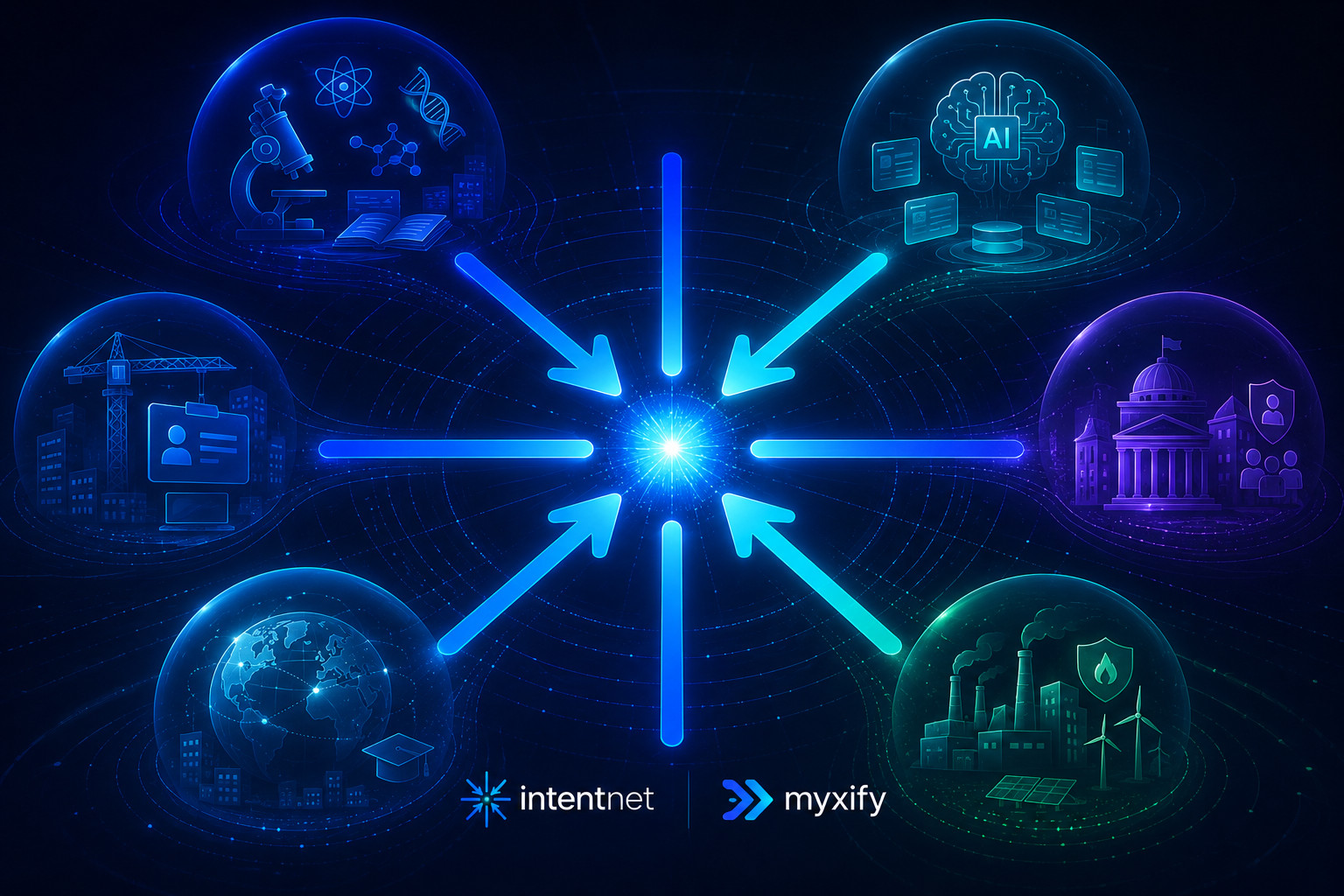
IntentNet is not a collection of environments. It is a framework for creating environments wherever digital access influences outcomes.
The Larger Opportunity
Most digital environments today evolved organically.
Organizations adopted technologies as needs emerged.
New applications were added.
New platforms were integrated.
New services became available.
Over time, digital ecosystems became increasingly complex.
Yet despite this complexity, a surprisingly simple question often remains unanswered.
What is this environment actually designed to achieve?
IntentNet begins by answering that question.
The objective becomes the starting point.
The environment becomes a deliberate design choice rather than an accidental collection of technologies.
Once that principle is established, entirely new categories of environments become possible.
Research Environments
Research represents one of the most natural applications of IntentNet.
Modern researchers depend on a wide variety of digital resources.
These may include:
- Academic journals
- Scientific databases
- Research repositories
- Computational platforms
- AI-assisted discovery tools
- Specialized software
- Collaboration environments
- Institutional resources
Research environments must balance openness and governance.
Researchers need the freedom to explore new ideas, discover emerging resources, and collaborate across institutional boundaries.
At the same time, institutions must manage compliance requirements, licensing restrictions, funding obligations, security expectations, and operational oversight.
IntentNet provides a framework for balancing these competing demands.
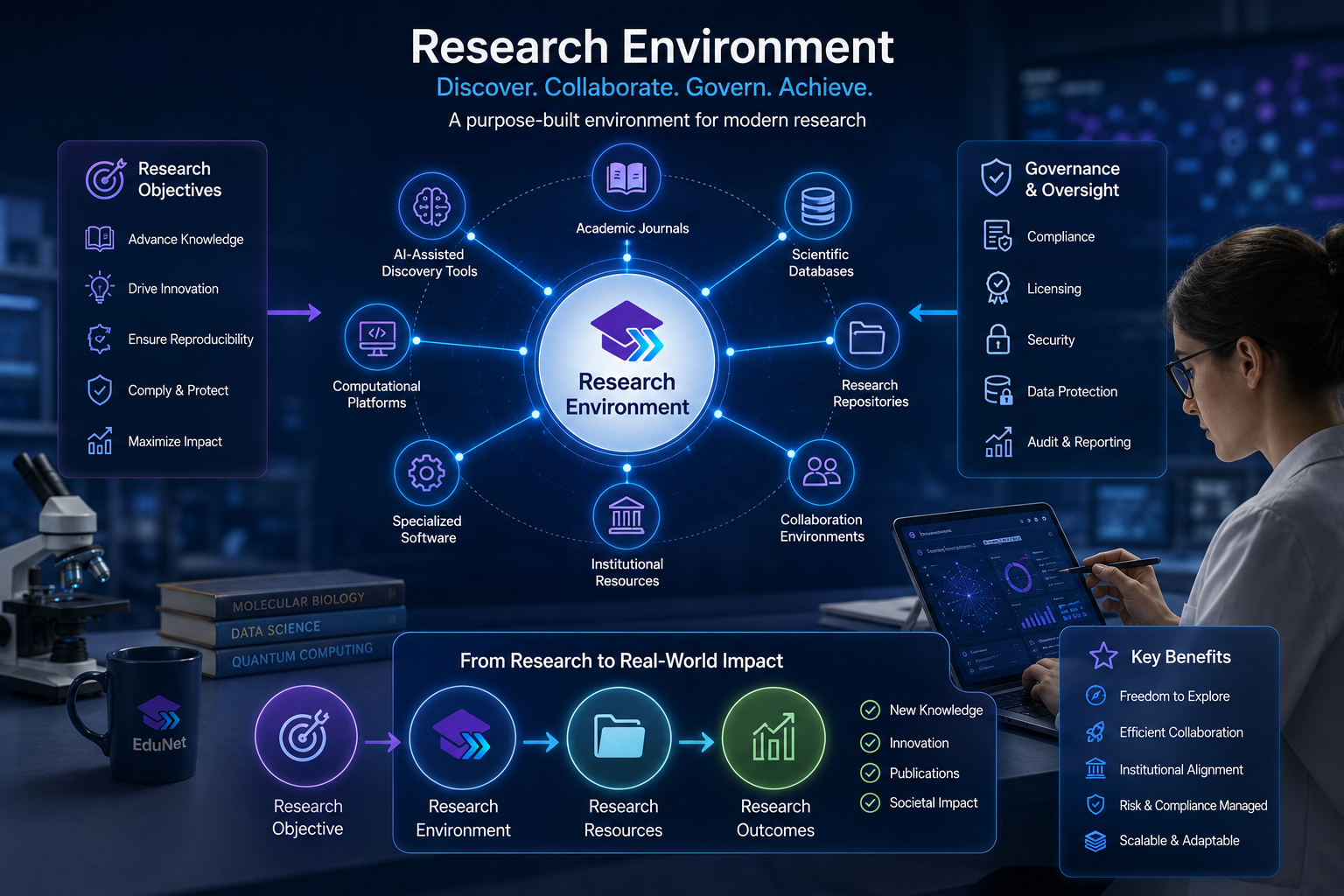
Research Objective
↓
Research Environment
↓
Research Resources
↓
Research Outcomes
The environment evolves around discovery while remaining aligned with institutional goals.
AI Ecosystems
Artificial intelligence presents another compelling opportunity.
Many organizations are currently adopting AI through a fragmented process.
Teams experiment independently.
Employees discover tools on their own.
Departments develop separate governance practices.
Technology portfolios expand rapidly.
The result is often a collection of disconnected AI initiatives.
IntentNet introduces a different possibility.
Rather than managing individual AI tools, organizations can design environments specifically intended to support responsible AI adoption.
Such environments may include:
- Approved models
- Approved assistants
- Data governance controls
- Experimentation zones
- Review workflows
- Access policies
- Organizational guidance
The focus shifts from individual technologies to the ecosystem as a whole.
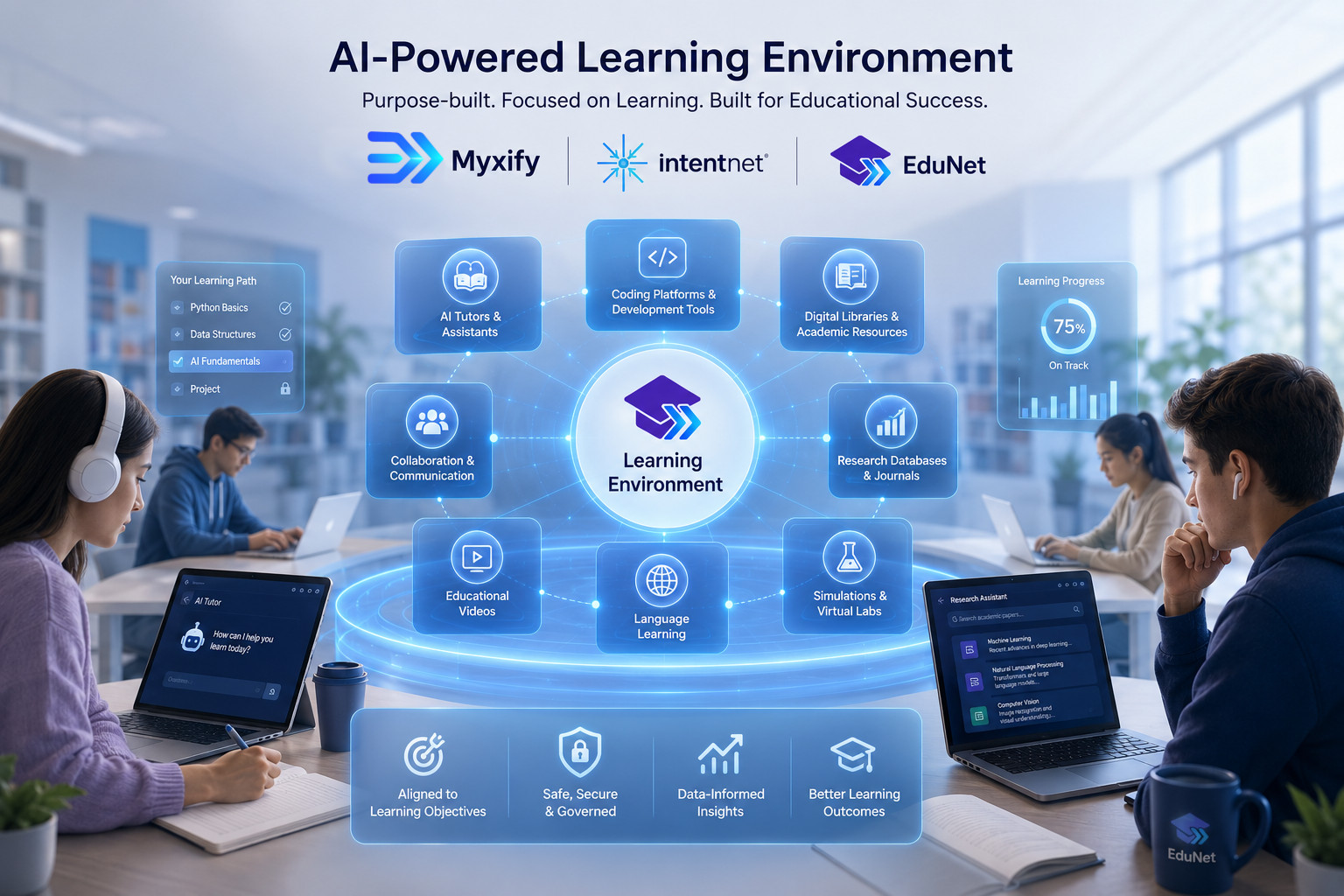
Project And Contractor Environments
Modern organizations increasingly rely on external contributors.
Consultants.
Contractors.
Research partners.
Implementation teams.
Specialized vendors.
The challenge is rarely whether access should exist.
The challenge is ensuring that access remains proportional to purpose.
External contributors often require access to specific resources for a specific period of time.
They rarely require unrestricted access to every organizational system.
IntentNet enables environments aligned with projects, programs, contracts, and collaborative initiatives.
Access becomes intentional.
Not excessive.
Public Service Environments
Governments and public-sector institutions face a unique combination of responsibilities.
They must provide services at scale.
Operate transparently.
Maintain accountability.
Comply with regulations.
Serve diverse populations.
And increasingly deliver those services through digital platforms.
In many cases, public-sector organizations require environments that balance accessibility, governance, privacy, operational efficiency, and public trust.
IntentNet offers a framework for organizing digital environments around public objectives rather than purely technical considerations.
This may become increasingly important as digital public infrastructure continues to expand.
Industry-Specific Environments
Many industries operate under unique constraints.
Healthcare organizations must balance patient care, privacy, compliance, and innovation.
Financial institutions must manage risk, regulation, security, and operational efficiency.
Energy providers must protect critical infrastructure while supporting increasingly digital operations.
Manufacturing organizations rely on specialized systems, supply chains, and industrial platforms.
These environments often require governance models that differ substantially from those found in education or enterprise collaboration.
IntentNet allows environments to be designed around the specific objectives and constraints of each sector.
The underlying principles remain consistent.
The implementation adapts to the context.
Shared And National Environments
Some opportunities extend beyond individual organizations.
Educational networks.
Research communities.
Industry ecosystems.
Regional collaborations.
National initiatives.
These environments frequently involve multiple stakeholders operating under shared objectives.
IntentNet provides a framework for coordinating resources, governance, access models, and operational objectives across organizational boundaries.
Such environments may become increasingly important as societies continue investing in digital infrastructure, research collaboration, workforce development, and artificial intelligence.
Every Objective Can Become An Environment
One useful way to understand IntentNet is through a simple thought experiment.
Start with an objective.
Then ask:
What kind of environment would best support that objective?
The answer may lead to:
- Learning environments
- Work environments
- Research environments
- Healthcare environments
- Innovation environments
- Public-service environments
- AI ecosystems
- Operational environments
- Industry-specific platforms
Or categories that have not yet been imagined.
The objective changes.
The design philosophy remains remarkably consistent.
Purpose.
Environment.
Resources.
Outcomes.
Beyond Products
EduNet and WorkNet are important because they make the concept tangible.
People can immediately understand the value of environments designed around learning or productive work.
Yet those environments represent only the beginning.
The broader opportunity lies wherever digital access influences outcomes.
As organizations become increasingly digital, more leaders are beginning to recognize that environments deserve intentional design.
Not every organization requires the same environment.
Not every objective requires the same resources.
And not every challenge should be solved using the same model.
That realization opens the door to an entirely new category of digital infrastructure.
Looking Ahead
The internet connected people to information.
The next generation of digital infrastructure may increasingly focus on connecting people to purpose.
If that happens, the most important question will no longer be:
What resources are available?
Instead it may become:
What environment best supports the outcome we are trying to achieve?
EduNet answers that question for learning.
WorkNet answers that question for productive work.
The next answers have yet to be discovered.
The Simplest Explanation
EduNet and WorkNet demonstrate what purpose-built digital environments can look like.
IntentNet asks a much larger question.
What becomes possible when digital environments are intentionally designed around objectives rather than generic connectivity?
The answer extends far beyond education and work.
And we are only beginning to explore it.
Final Article: Let's Build What's Next
The future of purpose-built digital environments will not be created by technology alone. It will be shaped by organizations, educators, researchers, innovators, and leaders willing to rethink how digital environments should work.
Founder Letter
Let's Build What's Next With Myxify
Technology matters. Infrastructure matters. Products matter. But every meaningful project begins with a question: what are you trying to achieve?
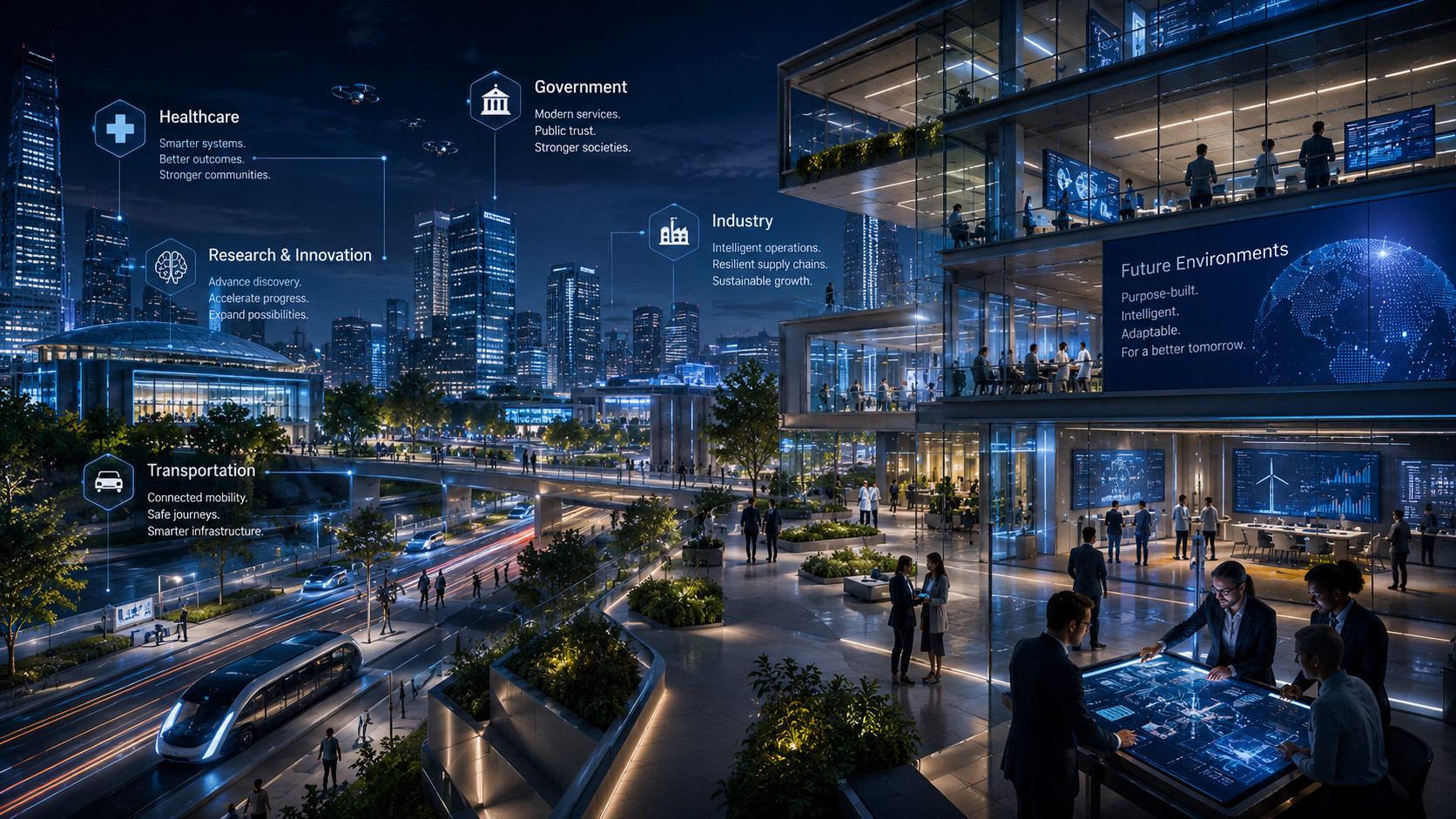
Let's Build What's Next With Myxify
By Paymon Parsi, CEO of Myxify
Over the last several articles, we explored an idea.
An idea that began with a simple observation.
The internet solved connectivity.
The next challenge is purpose.
We discussed IntentNet.
We explored EduNet.
We explored WorkNet.
We talked about AI governance, Guided Access, Access Intelligence, Policy Integrity, and purpose-built environments.
But none of those things are the destination.
They are only the beginning.
Technology Is Rarely The Starting Point
One lesson has remained consistent throughout my career.
Organizations rarely begin with technology.
They begin with challenges.
A school wants to improve learning outcomes.
A company wants to improve productivity.
A research institution wants to accelerate discovery.
A public organization wants to deliver better services.
A team wants to embrace AI responsibly.
Technology becomes valuable only when it helps solve those challenges.
That is why Myxify always starts with the objective.
Not the product.
Not the platform.
Not the architecture.
The objective.
Sometimes The Answer Is EduNet
Many educational institutions face a familiar problem.
Students need digital resources.
Teachers need consistency.
Administrators need governance.
Parents need trust.
EduNet was created to help solve that challenge.

Sometimes The Answer Is WorkNet
Organizations face a different reality.
Distributed teams.
Contractors.
Cloud platforms.
AI systems.
Operational complexity.
WorkNet was created to help organizations build productive digital work environments aligned with their goals.

Sometimes The Answer Does Not Exist Yet
This is the part that excites us most.
Some organizations come to us with challenges that do not fit neatly into existing categories.
Research initiatives.
AI ecosystems.
National education programs.
Public service environments.
Industry-specific platforms.
Regulated operational environments.
These conversations often lead somewhere unexpected.
Not toward a product.
Toward a new environment.
And sometimes toward something entirely new.
Why We Built IntentNet
IntentNet was never designed to become a single application.
Or a single platform.
Or even a single category.
It was designed to answer a question.
What happens when digital environments are designed around purpose instead of generic connectivity?
We believe that question will become increasingly important over the next decade.
As AI expands.
As work changes.
As learning evolves.
As organizations become more digital.
Purpose will matter more.
Not less.
Start Small
One of the biggest misconceptions about innovation is that it requires massive projects.
Most successful transformations begin modestly.
One classroom.
One department.
One research group.
One team.
One pilot.
One objective.
The goal is not to change everything.
The goal is to learn.
Then improve.
Then expand.
The Conversation We'd Like To Have
If you contact Myxify, I hope the first conversation is not about technology.
I hope it is about your objective.
What are you trying to accomplish?
What challenges are slowing progress?
What outcomes matter most?
What kind of environment would help people succeed?
Those questions are far more important than product specifications.
The technology conversation can come later.
An Invitation
Whether you represent a school, a university, a company, a government organization, a research institution, or a new idea that does not yet fit an existing category, I invite you to start a conversation.
Not about products.
About possibilities.
Because the future will not be defined by access alone.
It will be defined by what people are able to achieve once they have it.
And that is the future we are building at Myxify.
Let's Build What's Next
If any part of this journey resonates with you, reach out.
Tell us about your challenge.
Tell us about your objective.
Tell us what you're trying to build.
We'll start there.
Because every meaningful environment begins with purpose.
And every meaningful outcome begins with a conversation.
Start The Conversation
Explore EduNet, WorkNet, IntentNet, or discuss a custom environment with the Myxify team.
READING JOURNEY
Continue Reading
Let's Build What's Next With Myxify
Continue ReadingRELATED ARTICLES
Keep exploring the knowledge hub.
 IntentNet
What Is IntentNet?
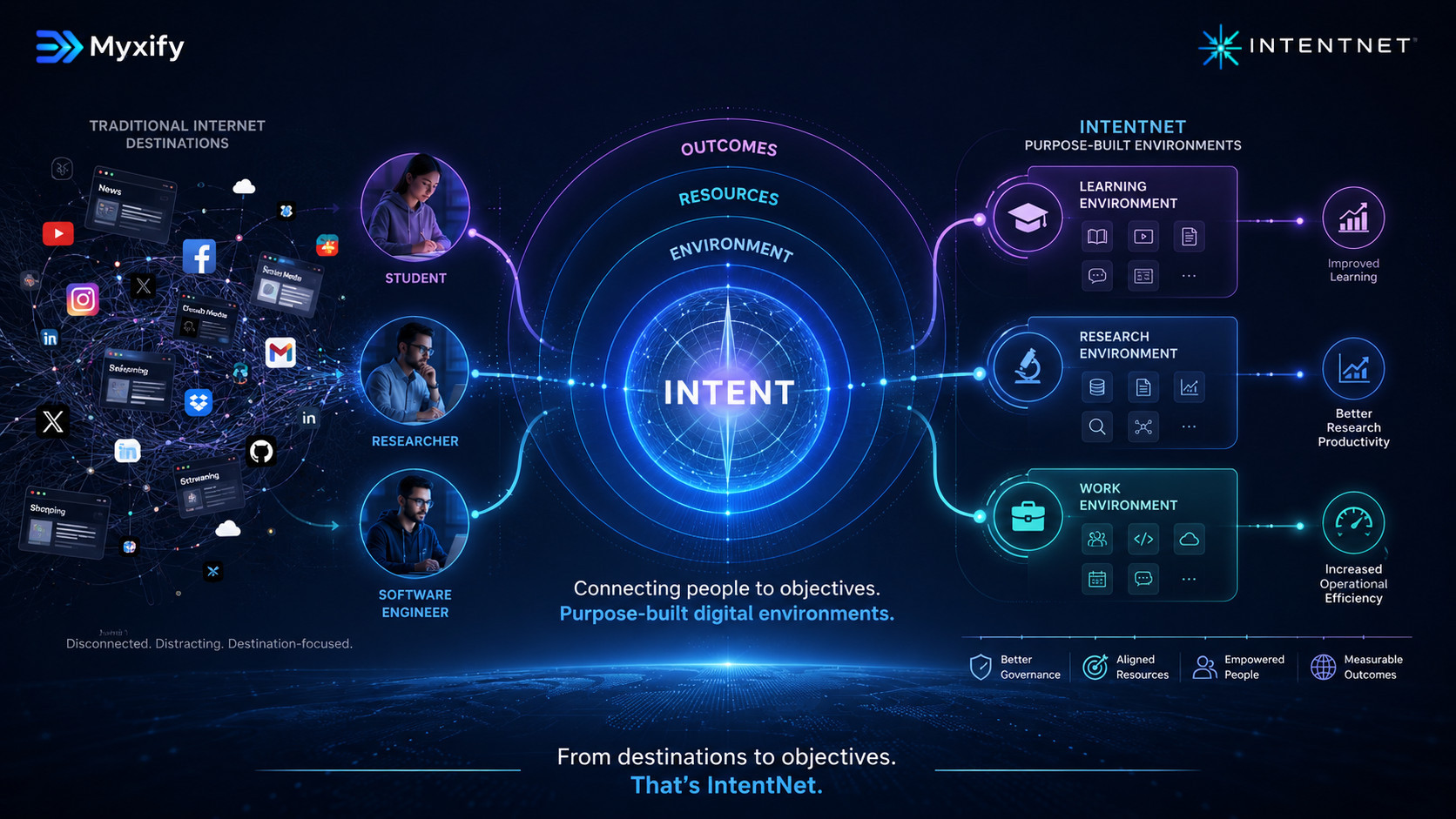
IntentNet is a foundation for creating purpose-built digital environments. Instead of organizing access around destinations and networks, IntentNet organizes access around intent, environments, resources, and outcomes.
 WorkNet
WorkNet: Work Internet for Modern Teams
Modern organizations depend on SaaS platforms, cloud services, AI assistants, contractors, and distributed teams. WorkNet creates environments designed around productive work rather than unrestricted internet access.
Founder LetterLet's Build What's Next With Myxify
Technology matters. Infrastructure matters. Products matter. But every meaningful project begins with a question: what are you trying to achieve?