
Table of contents
What Is IntentNet?
After discussing why digital access is changing, a natural question follows.
What exactly is IntentNet?
The simplest answer is this:
IntentNet is a foundation for creating purpose-built digital environments.
It helps organizations align digital access with what people are trying to accomplish.
That explanation is simple.
The implications are not.
IntentNet helps organizations design digital environments around purpose rather than simply managing connectivity.
Starting With The Wrong Question
Most access technologies begin with technical questions.
Examples include:
- Who is the user?
- Is the user authenticated?
- Is the destination allowed?
- Is the connection secure?
- Does policy permit the request?
These are valid questions.
Every modern organization needs answers to them.
But they share a common assumption.
They treat access primarily as a connectivity problem.
IntentNet starts somewhere else.
Before asking whether a connection should occur, IntentNet asks:
What is the person trying to accomplish?
That single question changes the design model.

The Core Idea
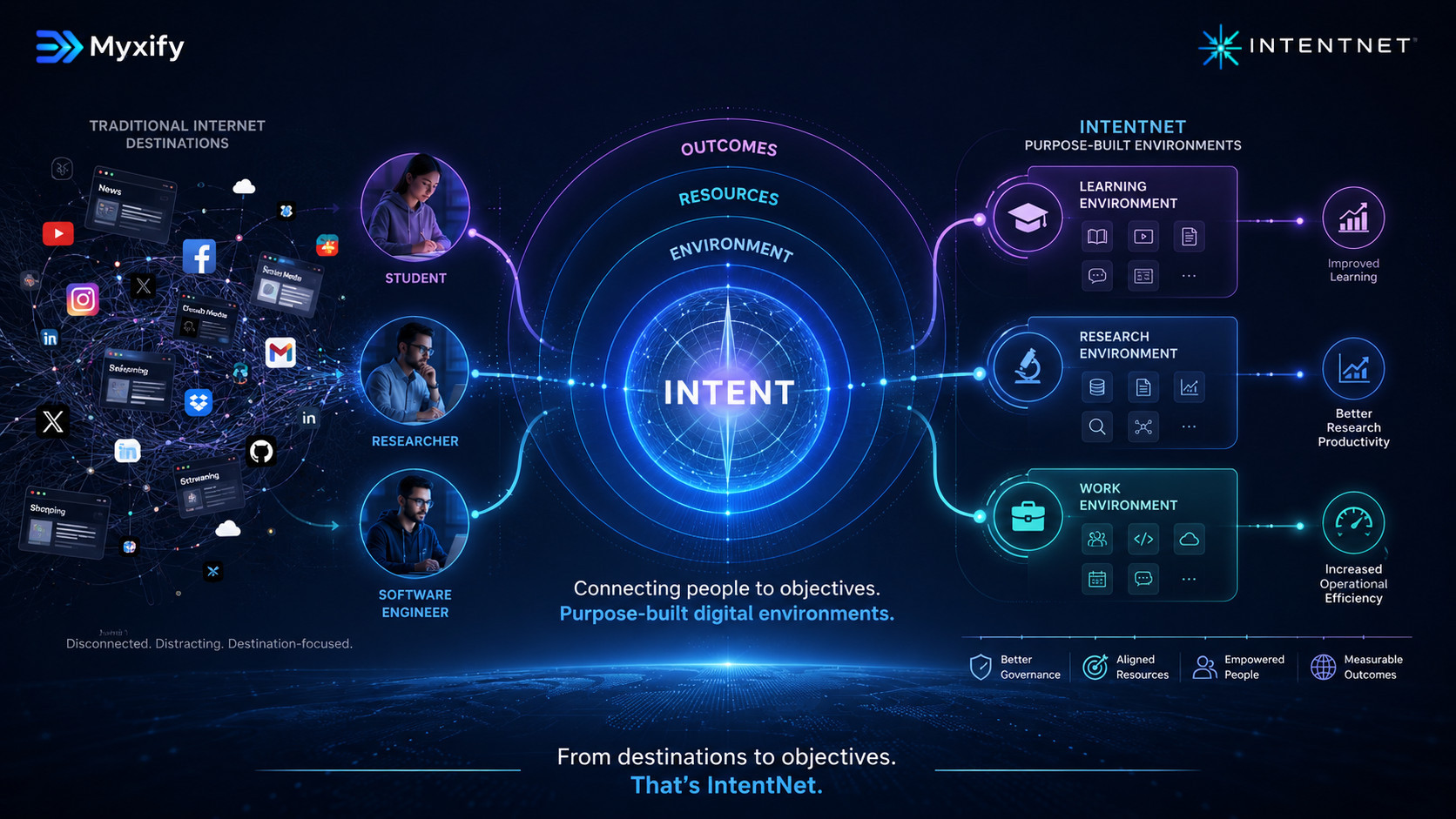
Imagine three people.
A student.
A researcher.
A software engineer.
All three may use the internet.
All three may use AI systems.
All three may use cloud services.
Yet their objectives are completely different.
The student wants to learn.
The researcher wants to discover.
The engineer wants to build.
Traditional access systems often treat these individuals similarly.
IntentNet does not.
IntentNet treats purpose as a first-class design principle.
The IntentNet Model
IntentNet organizes digital access around four connected elements.
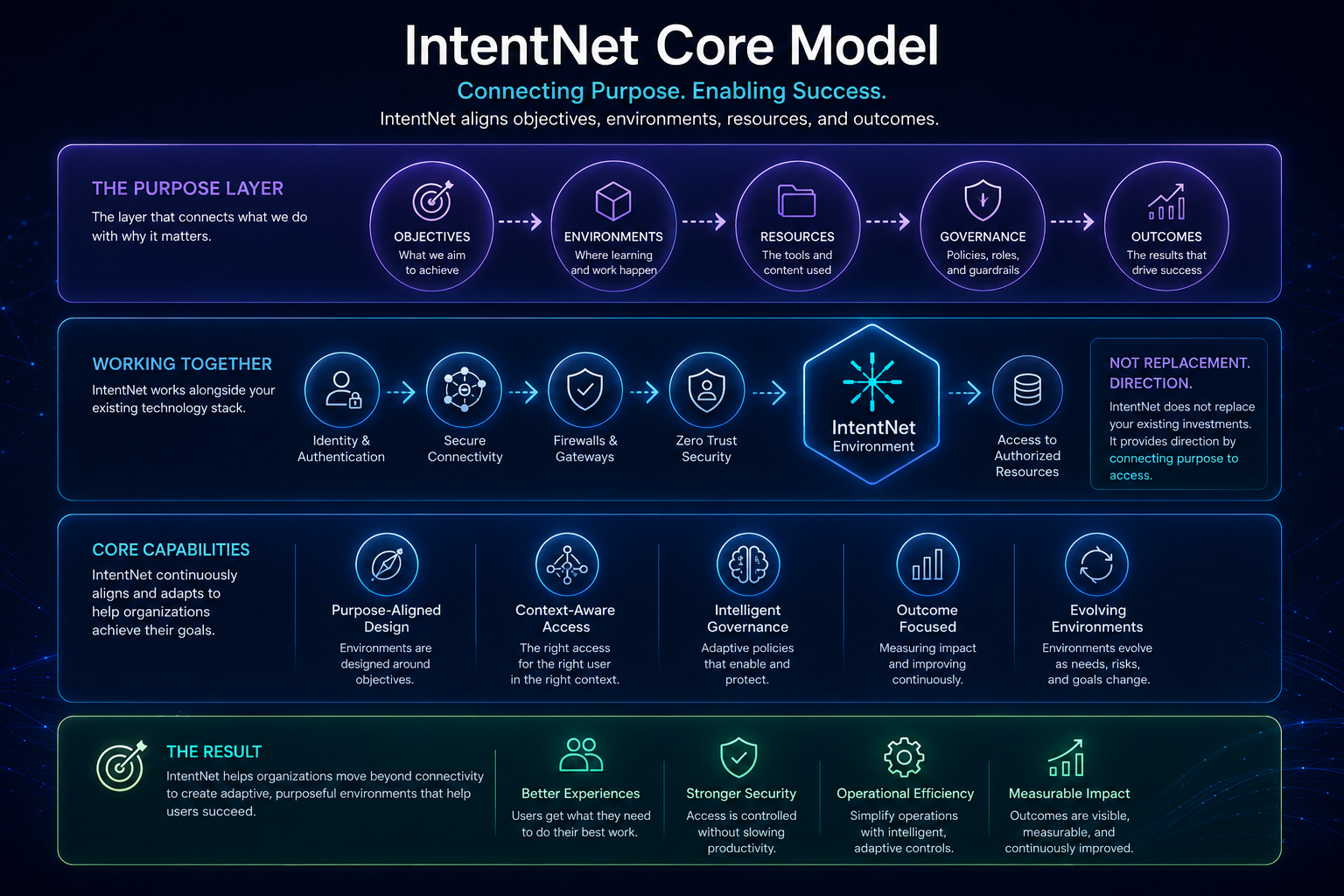
Intent
What is the person or organization trying to accomplish?
Examples:
- Learning
- Research
- Work
- Operations
- Collaboration
- Innovation
Intent provides direction.
Environment
An environment is a digital space designed around an objective.
Examples include:
- Learning environments
- Research environments
- Work environments
- Operational environments
The environment becomes the primary unit of design.
Resources
Resources are the services, platforms, applications, tools, and destinations that support the environment.
A resource belongs inside an environment because it helps achieve the objective.
Not simply because it exists.
Outcomes
Outcomes explain why the environment exists.
Examples may include:
- Improved learning
- Better research productivity
- Increased operational efficiency
- Faster innovation
- Better governance
Outcomes are the ultimate measure of success.
Environments Instead Of Destinations
One of the easiest ways to understand IntentNet is to compare two different approaches.
Traditional thinking often asks:
Is this website allowed?
IntentNet asks:
Does this resource belong inside the intended environment?
At first glance the difference appears small.
In practice it is significant.
The first question focuses on destinations.
The second focuses on purpose.
Purpose provides context.
Context improves decision making.
Traditional systems manage destinations. IntentNet manages environments.
A Learning Example
Consider a university.
Traditional approaches might focus on lists of approved websites, categories, and policies.
IntentNet begins with the learning objective.
The environment is designed to support students and educators.
Resources are selected because they contribute to learning.
When new resources become valuable, the environment can evolve.
The objective remains constant.
Learning.
The environment adapts around that objective.

A Work Example
Now consider a modern organization.
Employees rely on collaboration platforms, cloud services, development tools, AI assistants, operational systems, and external resources.
The challenge is not merely deciding what should be blocked.
The challenge is creating an environment that supports productive work.
IntentNet allows organizations to design environments around work objectives rather than individual destinations.
The emphasis shifts from restriction to alignment.

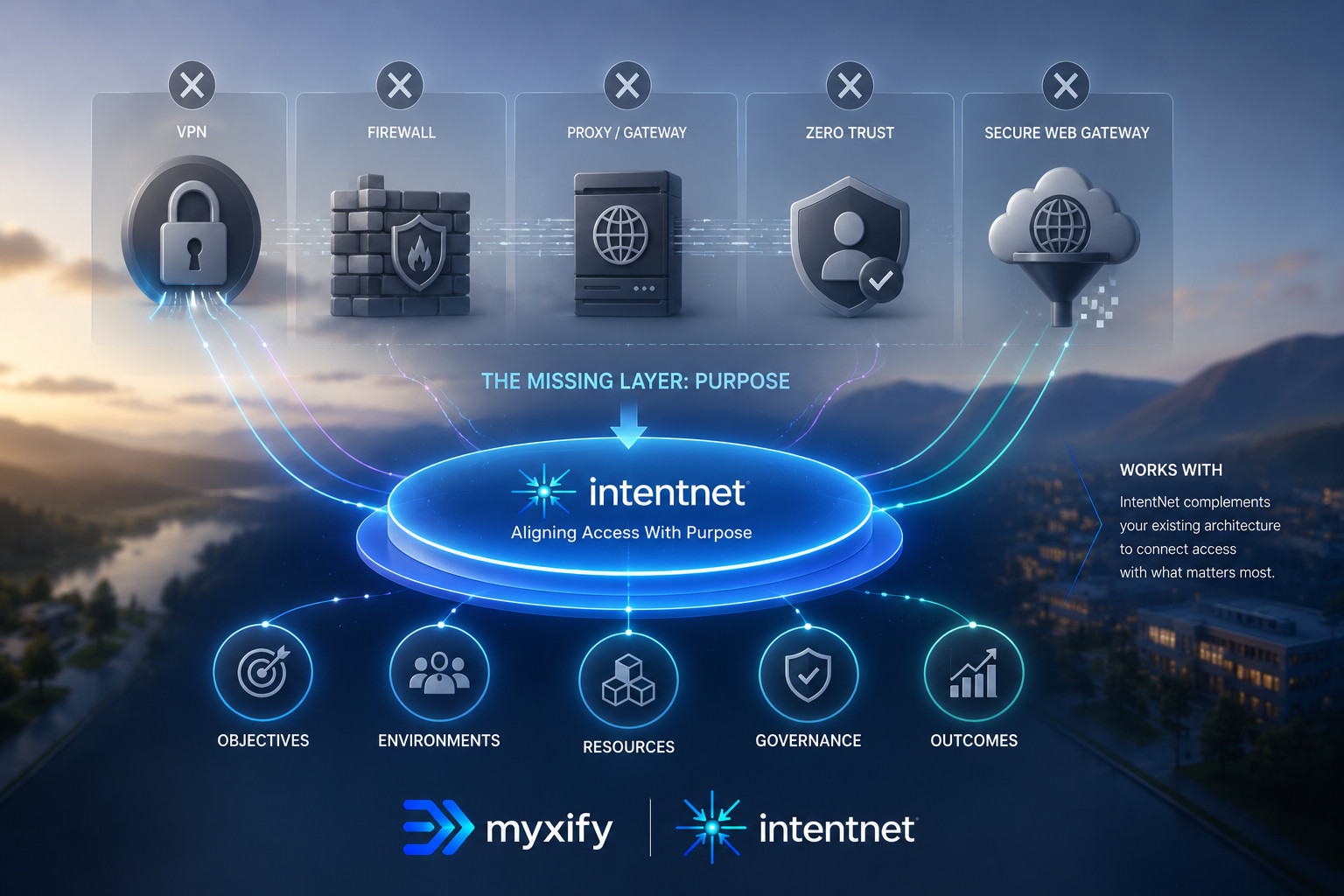
Why IntentNet Is Not A Product Category
People often try to compare IntentNet with existing technologies.
Questions frequently include:
- Is it a VPN?
- Is it a proxy?
- Is it Zero Trust?
- Is it a firewall?
- Is it a filtering platform?
The answer is no.
IntentNet is not attempting to replace those technologies.
Those technologies solve important problems.
Identity.
Connectivity.
Security.
Inspection.
Policy enforcement.
IntentNet operates at a different level.
It helps define why environments exist and how they should evolve.
Existing technologies can participate inside an IntentNet architecture.
IntentNet gives them direction.
[RELATED_ARTICLES:title=Read Next|items=intentnet-is-not-a-vpn-firewall-proxy-or-zero-trust,how-intentnet-works]
A Foundation, Not A Single Environment
IntentNet was never designed for a single product.
It was designed as a foundation.
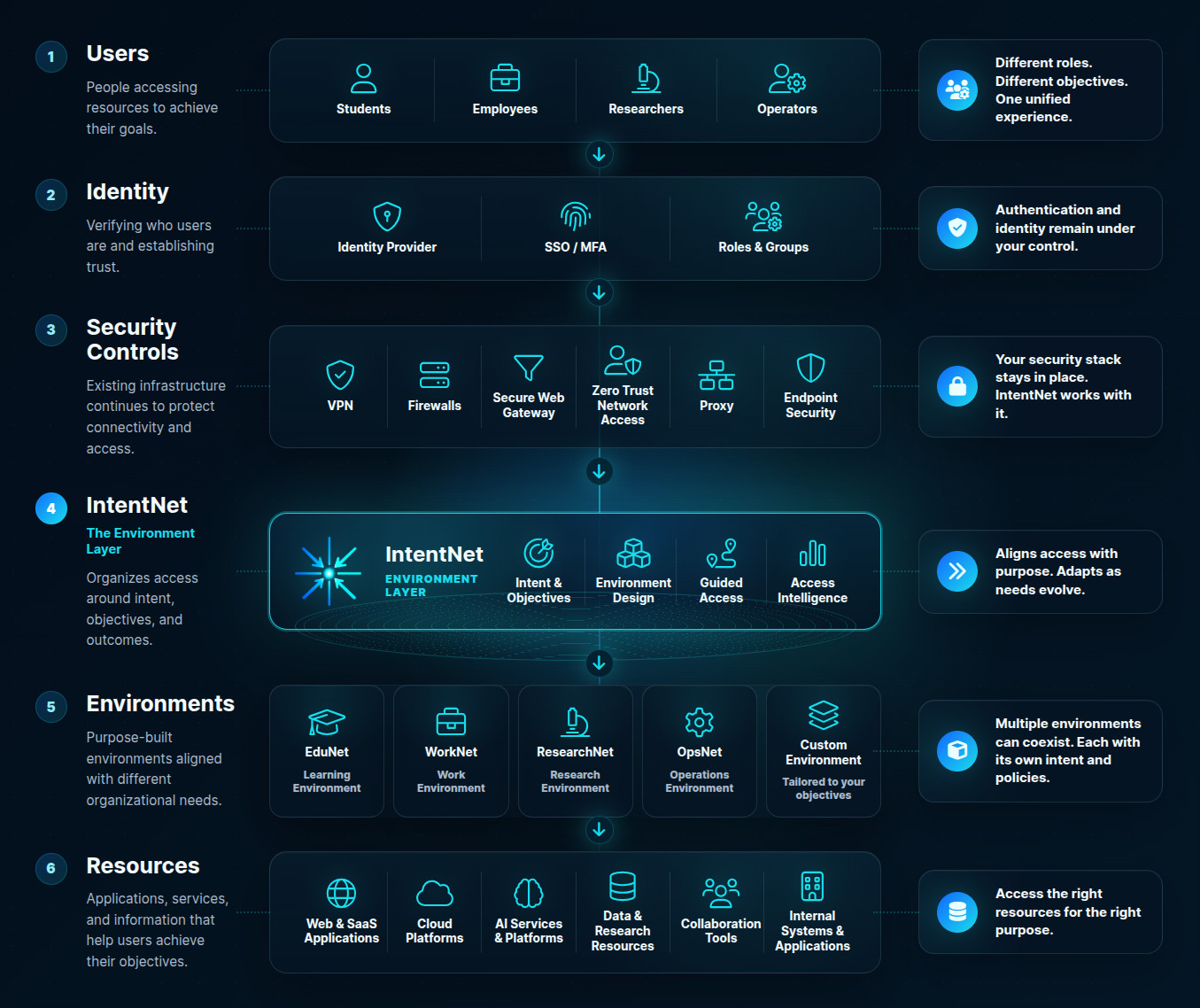
Today that foundation powers:
EduNet
Purpose-built learning environments.
WorkNet
Purpose-built work environments.
Tomorrow it may support:
- Research environments
- AI ecosystems
- Public service environments
- Industry-specific platforms
- Operational environments
- New categories that do not yet exist
The environments may change.
The foundation remains the same.
Why The Concept Matters
The internet connected people to information.
IntentNet helps organizations connect people to objectives.
That shift may sound subtle.
But it changes how environments are designed.
How governance evolves.
How resources are selected.
How outcomes are measured.
And ultimately how organizations think about digital access.
The One-Sentence Definition
If you remember only one thing from this article, remember this:
IntentNet is a foundation for creating purpose-built digital environments aligned with organizational objectives, resources, governance, and outcomes.
Continue The Journey
Now that you understand the model, the next step is understanding how IntentNet actually works in practice.
Architecture
How IntentNet Works
IntentNet starts with purpose, creates environments around objectives, supports Guided Access, learns through Access Intelligence, and continuously evolves. Here's how the model works in practice.
How IntentNet Works
By now we've explored why IntentNet exists and what it is.
The next question is practical.
How does IntentNet actually work?
The answer begins with a shift in perspective.
Traditional systems focus on destinations.
IntentNet focuses on purpose.
Everything else follows from that decision.
Traditional Access Starts With Connections
Most digital access systems follow a familiar path.
User
→ Identity
→ Network
→ Internet
→ Destination
→ Policy Decision
The system evaluates:
- Who the user is
- Which device they use
- Where they are located
- Which destination they are trying to reach
- Whether policy permits the request
This model works well when connectivity is the primary objective.
IntentNet addresses a different challenge.
Traditional systems optimize connections.
IntentNet optimizes environments.
IntentNet Starts With Purpose
Before discussing websites, applications, domains, or services, IntentNet asks a more fundamental question.
What is this person trying to accomplish?
Examples include:
- Learning
- Research
- Productive work
- Collaboration
- Operations
- Innovation
Purpose becomes the foundation for every decision that follows.
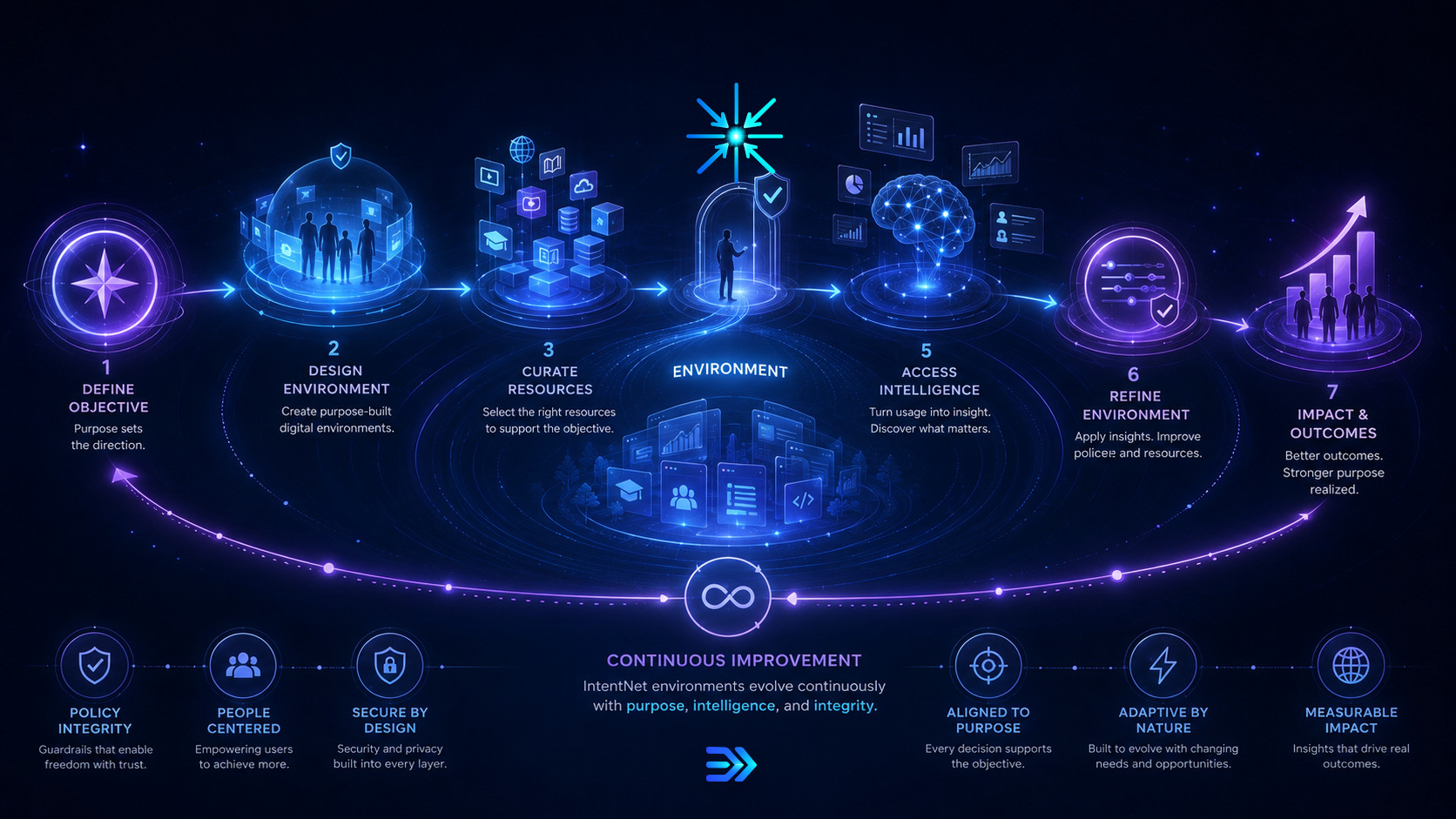
The IntentNet Lifecycle
Everything in IntentNet can be understood through a simple lifecycle.

Intent
↓
Environment Design
↓
Resources
↓
Usage
↓
Guided Access
↓
Access Intelligence
↓
Refinement
↓
Improved Outcomes
Unlike traditional access systems, the process does not end when a connection is approved.
The environment continuously evolves.
Step 1: Define The Objective
Every environment begins with an objective.
A university may prioritize learning.
A research institute may prioritize discovery.
A company may prioritize productive work.
A government agency may prioritize service delivery.
IntentNet treats these objectives as design requirements.
Without a clear objective, there is no meaningful environment.
Step 2: Design The Environment
Once the objective is understood, an environment can be created.
An environment is more than a collection of websites.
It is a digital space intentionally designed to support a specific outcome.
Examples include:
- Learning environments
- Research environments
- Work environments
- Operational environments
This is where IntentNet differs most from traditional filtering and policy systems.
The environment becomes the unit of design.
Step 3: Select Resources
Every environment contains resources.
These may include:
- Websites
- Applications
- SaaS platforms
- AI assistants
- Research databases
- Collaboration tools
- Internal systems
The question is not simply:
Is this resource safe?
The question becomes:
Does this resource support the purpose of the environment?
This shift changes how organizations think about access.
Step 4: Support Real Work
Once an environment is active, people begin using it.
Students learn.
Researchers discover.
Employees collaborate.
Teams deliver outcomes.
At this stage, existing technologies continue to play important roles.
Identity systems.
Security systems.
Firewalls.
Secure gateways.
Zero Trust architectures.
IntentNet does not replace them.
It provides direction.
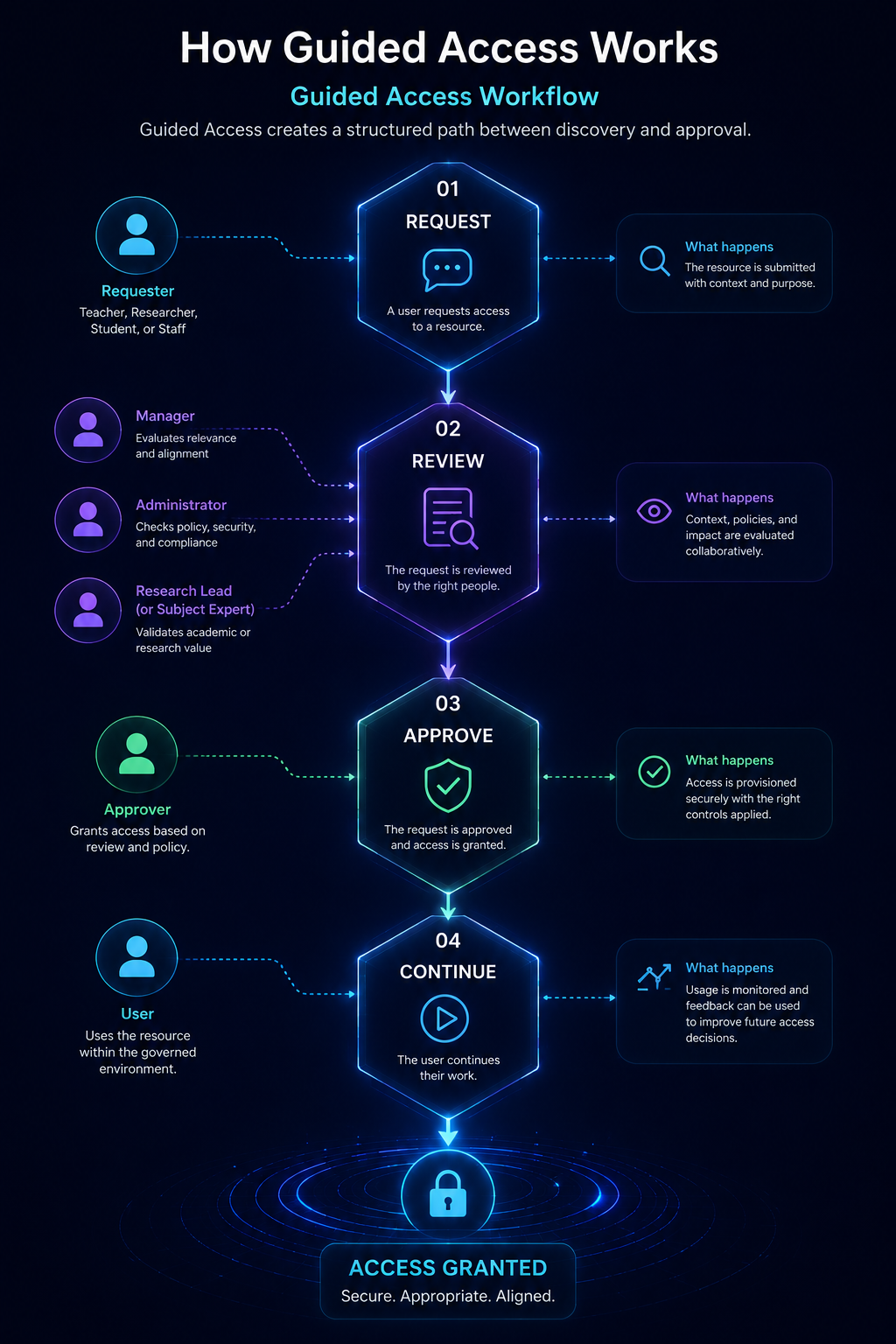
Step 5: Guided Access Enables Evolution
No environment can predict every future need.
New AI tools appear.
New learning resources emerge.
New research platforms become valuable.
Traditional systems often force organizations into a binary choice.
Allow.
Or deny.
IntentNet introduces a third option.
Request.
Request
↓
Review
↓
Approve
↓
Continue
This approach enables flexibility while maintaining governance.
Step 6: Access Intelligence Creates Understanding
Traditional visibility focuses heavily on activity.
Connections.
Traffic.
Sessions.
Bandwidth.
IntentNet asks different questions.
- Which resources are creating value?
- Which requests appear repeatedly?
- Which environments are successful?
- Which policies create friction?
- Where are opportunities emerging?
This layer is called Access Intelligence.
Its purpose is understanding.
Not surveillance.

Step 7: Refine The Environment
Every environment should improve over time.
Guided Access generates feedback.
Access Intelligence generates insight.
Environment Design applies both.
Organizations can:
- Add resources
- Remove resources
- Improve workflows
- Refine governance
- Reduce friction
- Improve outcomes
This refinement process never stops.
The Four Building Blocks
IntentNet is ultimately built around four interconnected ideas.
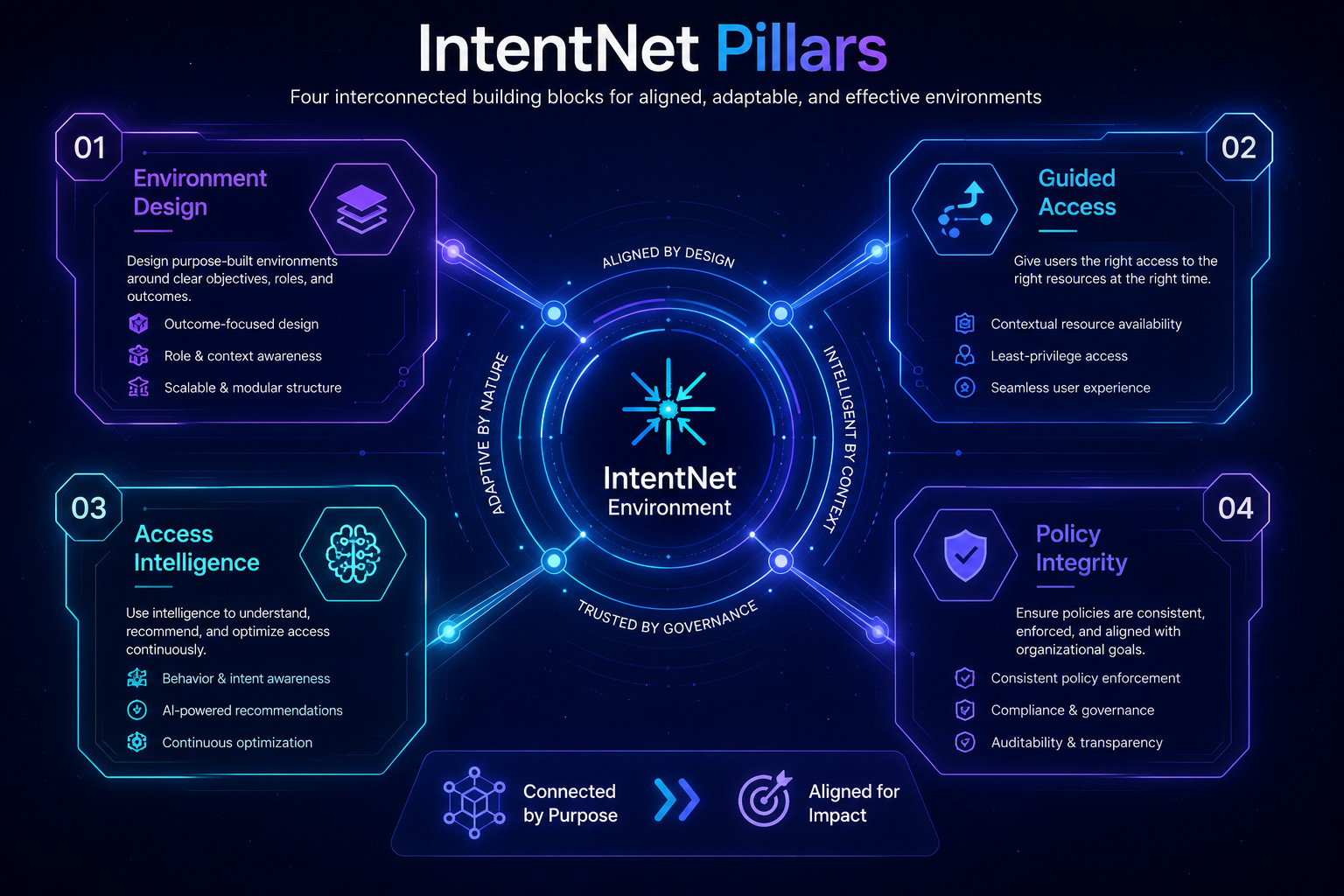
- Environment Design
- Guided Access
- Access Intelligence
- Policy Integrity
Together they create environments that can adapt without losing direction.
A University Example
Imagine a university deploying EduNet.
The objective is learning.
A learning environment is created.
Learning resources, AI tutors, coding platforms, digital libraries, academic journals, and collaboration tools become available.
Students use those resources.
Requests reveal emerging needs.
Faculty review and approve additions.
Access Intelligence identifies trends.
The environment improves.
The objective remains constant.
Learning.
The environment evolves around that objective.
The Simplest Explanation
IntentNet begins with purpose.
Designs environments around that purpose.
Allows those environments to evolve through Guided Access.
Learns through Access Intelligence.
Maintains alignment through Policy Integrity.
And continuously improves outcomes over time.
That is how IntentNet works.
Continue The Journey
Next, we'll explore why environment design begins with purpose and why environments are becoming more important than destinations.
Environment Design
Environment Design Starts With Purpose
Purpose-built digital environments are not collections of websites, applications, or policies. They are intentionally designed around objectives, outcomes, and the people they serve.

Environment Design Starts With Purpose
Many digital access initiatives begin with the wrong question.
The conversation often starts with websites.
Which sites should be allowed?
Which applications should be blocked?
Which domains belong on the approved list?
These questions are useful.
But they are not the best starting point.
IntentNet begins somewhere else.
It begins with purpose.
Before deciding which resources belong in an environment, first decide what the environment exists to achieve.
The Problem With Lists
Traditional access models often revolve around lists.
Lists of websites.
Lists of applications.
Lists of categories.
Lists of policies.
The challenge is that lists rarely explain intent.
A list can tell people what is available.
It cannot explain why.
Without purpose, environments become collections of disconnected decisions.
Purpose provides coherence.
Environments Are Not Resource Catalogs
A learning environment is not a list of educational websites.
A research environment is not a collection of databases.
A work environment is not a bundle of SaaS applications.
Those resources matter.
But they are not the environment.
The environment is the system that connects resources to objectives.
Intent
↓
Environment
↓
Resources
↓
Outcomes
Resources exist because they support the objective.
Not the other way around.
Design Around Outcomes
The most effective environments are designed backward from outcomes.
Instead of asking:
What resources should we provide?
IntentNet asks:
What outcome are we trying to achieve?
Examples include:
- Better learning outcomes
- Faster research cycles
- Increased productivity
- Stronger collaboration
- Responsible AI adoption
- Improved operational efficiency
Once the outcome is clear, environment design becomes far more intentional.
A Learning Environment Example
Imagine designing a university environment.
A traditional approach may focus on approved websites.
An IntentNet approach begins differently.
The objective is learning.
Everything else follows.
The environment may include:
- Academic resources
- Digital libraries
- Coding platforms
- AI tutors
- Collaboration tools
- Research references
Those resources belong because they support learning.
The environment remains coherent because the objective is clear.
A Work Environment Example
The same principle applies to organizations.
The objective may be productive work.
The environment may include:
- Communication platforms
- Project management systems
- Development tools
- Cloud services
- AI assistants
- Knowledge resources
The goal is not to expose every possible resource.
The goal is to support productive outcomes.
Clarity Creates Trust
One of the most overlooked aspects of environment design is transparency.
People should understand:
- Why resources are available
- Why some resources require approval
- How requests are evaluated
- How environments evolve
When users understand the reasoning behind an environment, trust increases.
When environments appear arbitrary, frustration grows.
Frustration often leads to workarounds.
Trust leads to participation.
People are more likely to embrace governance when they understand its purpose.
Design For Change
Many access models assume stability.
Reality rarely cooperates.
New technologies emerge.
New AI systems appear.
New research platforms become valuable.
New organizational priorities develop.
An effective environment must evolve.
Environment design therefore includes:
- A foundation
- A governance model
- A request process
- A feedback mechanism
- A path for improvement
Designing for change is just as important as designing for today.
Environment Design And Guided Access
This is where Guided Access becomes important.
No environment can predict every future requirement.
Guided Access provides a structured way to expand environments without losing direction.
Request
↓
Review
↓
Approve
↓
Continue
The environment remains aligned.
The organization remains adaptable.
Why Environment Design Matters
Every digital environment influences behavior.
The resources people encounter shape the resources they use.
The tools people discover shape the tools they adopt.
The environment influences the outcome.
This makes environment design a strategic activity.
It is not merely an administrative task.
It is not merely policy management.
It is the practice of intentionally creating conditions that support success.
The Fundamental Shift
Traditional systems design rules.
IntentNet designs environments.
Traditional systems focus on destinations.
IntentNet focuses on objectives.
Traditional systems ask:
Which resources should be allowed?
IntentNet asks:
What outcome are we trying to achieve?
That single shift changes everything.
Next: Guided Access
No environment can predict every future need. Next, explore how Guided Access helps environments evolve without losing alignment.
Guided Access
Guided Access: Guide Instead of Block
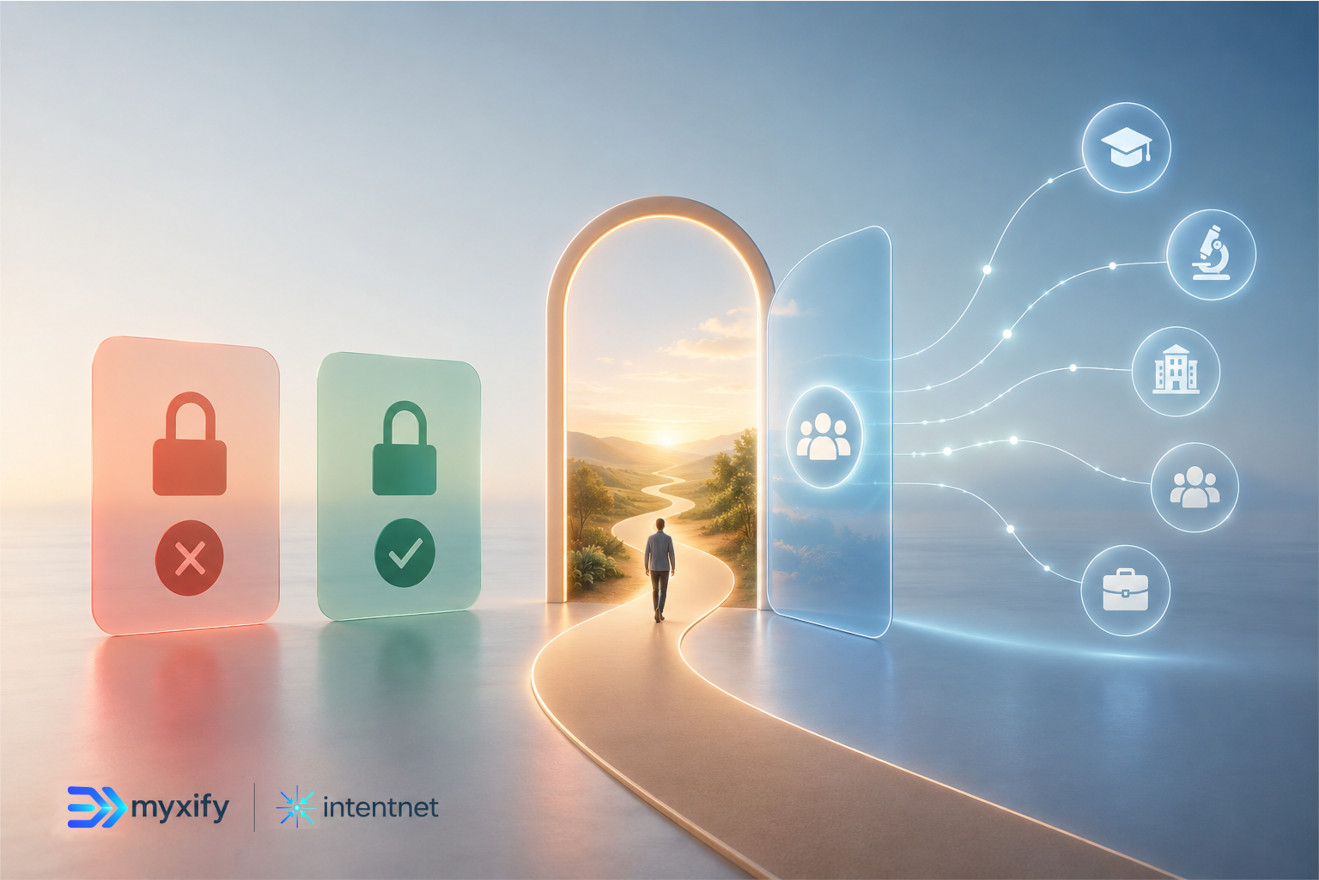
For decades digital access systems relied on two answers: yes or no. IntentNet introduces a third answer: not yet. Guided Access helps environments evolve without becoming unrestricted.
Guided Access: Guide Instead of Block
Most access systems have been asking the same question for decades.
Should this request be allowed?
Or denied?
Yes.
Or no.
Those answers seem reasonable.
Until you encounter something new.
And modern environments encounter something new every day.
The Problem With Binary Decisions
Imagine a student discovers a new educational platform.
Or a researcher finds a promising data source.
Or an employee wants to evaluate a new AI assistant.
Traditional systems often respond with only two possibilities.
Allow it.
Or block it.
Neither option is always correct.
Allowing everything eventually creates chaos.
Blocking everything eventually creates frustration.
The real world is rarely binary.
Yet many access systems still behave as if it is.
Guided Access introduces a third answer between yes and no.
The answer is: let's evaluate it.
The Missing Option
IntentNet introduces a simple concept.
When a resource is not part of an environment, users can request it.
That request enters a guided process.
Someone with context reviews it.
A decision is made.
The environment learns.
The environment evolves.
This sounds small.
But it changes the entire relationship between governance and innovation.
A Different Conversation
Traditional access conversations often sound like this:
User:
"I need access to this resource."
System:
"Denied."
Conversation over.
Guided Access creates a different conversation.
User:
"I need access to this resource."
Environment:
"Tell us why."
Reviewer:
"Let's evaluate it in context."
Decision:
"Approved for this project."
Or:
"Approved temporarily."
Or:
"Approved for this course."
Or:
"Added permanently to the environment."
The result is not simply more access.
The result is better decisions.
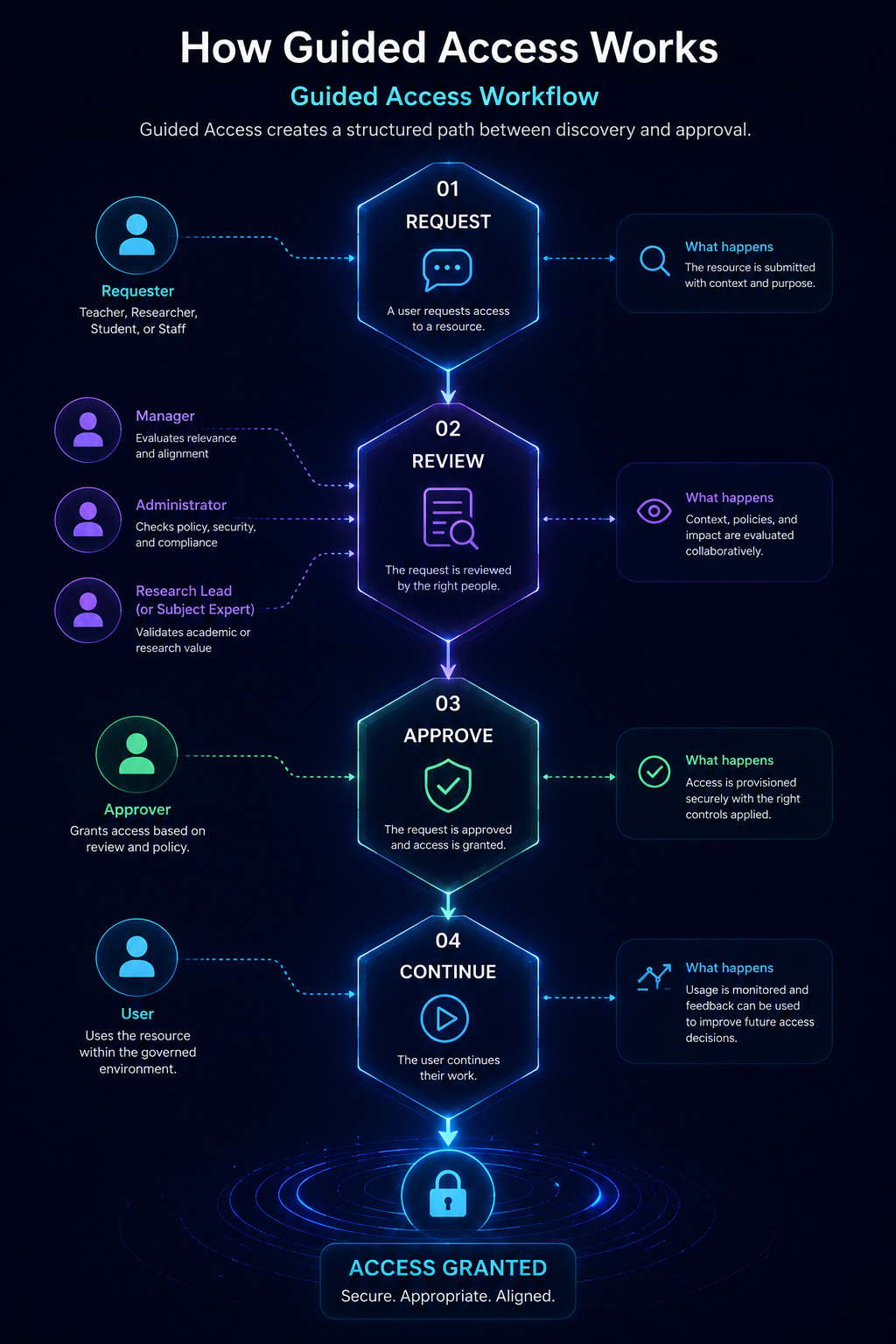
How Guided Access Works
At a high level the process is straightforward.
Request
↓
Review
↓
Approve
↓
Continue
The important detail is not the workflow itself.
The important detail is who participates in the decision.
Context Matters
Different environments require different reviewers.
In education, decisions may involve:
- Teachers
- Parents
- School administrators
In research environments:
- Principal investigators
- Lab leaders
- Research institutions
In organizations:
- Managers
- Project leaders
- Compliance officers
- Administrators
The objective is simple.
Place decisions in the hands of people who understand the environment.
Not Every Approval Should Last Forever
One of the most common mistakes in traditional access systems is treating every approval as permanent.
Many requests are temporary by nature.
A student may need a resource for one course.
A researcher may need a platform for one study.
A team may need a tool for one project.
Guided Access allows approvals to match reality.
Examples include:
- Session approvals
- Temporary approvals
- Course approvals
- Project approvals
- Department approvals
- Permanent approvals
Access becomes proportional to need.
Requests Reveal What Matters
One of the most interesting aspects of Guided Access is that requests themselves become valuable.
Every request tells a story.
It reveals:
- Emerging technologies
- Missing resources
- User needs
- New opportunities
- Friction points
Organizations often focus on the approval.
But the request may be the more valuable signal.
A pattern of requests often reveals where environments should evolve next.
Guided Access And Access Intelligence
This is where Guided Access connects to the next pillar of IntentNet.
Requests create insight.
Insight creates understanding.
Understanding creates improvement.
Access Intelligence helps organizations recognize patterns that individual approvals might miss.
Repeated requests are often telling the organization something important.
The best environments listen.
[RELATED_ARTICLES:title=Continue Reading|items=access-intelligence-without-surveillance,policy-integrity-preserving-purpose-over-time]
Guidance Creates Trust
People generally accept governance when they understand it.
What frustrates users is not necessarily restriction.
It is unpredictability.
Guided Access creates transparency.
Users know:
- How requests work
- Who reviews them
- Why decisions are made
- How environments evolve
Clarity reduces conflict.
Transparency builds trust.
Trust encourages participation.
The Bigger Shift
At first glance Guided Access appears to be an approval workflow.
It is much more than that.
It changes the philosophy of access.
Traditional systems assume environments should remain fixed.
IntentNet assumes environments should learn.
Traditional systems ask:
Should we allow this?
Guided Access asks:
Should the environment evolve?
That is a fundamentally different question.
The Simplest Explanation
Traditional systems allow.
Or deny.
IntentNet allows.
Requests.
Learns.
And evolves.
That is Guided Access.
Next: Access Intelligence
Every request teaches something. Next, explore how IntentNet transforms activity and requests into insight without turning people into surveillance targets.
Access Intelligence
Access Intelligence Without Surveillance
Organizations need visibility. Users need privacy. The challenge is obtaining meaningful operational insight without turning digital environments into surveillance systems.

Access Intelligence Without Surveillance
Organizations need visibility.
Educational institutions need to understand whether learning environments are effective. Research organizations need to identify friction that slows discovery. Businesses need insight into how digital environments support productivity and operational goals.
The need for visibility is not controversial.
The challenge begins when visibility is confused with surveillance.
Over the past two decades, many digital systems have evolved toward increasingly comprehensive forms of monitoring. Advances in storage, analytics, cloud computing, and artificial intelligence have made it technically possible to collect vast quantities of information about user activity.
Yet the ability to collect data does not automatically justify collecting it.
In many cases, organizations are discovering that excessive monitoring creates new risks while providing surprisingly little additional understanding.
The real question is not how much data can be collected.
The real question is what information is necessary to improve the environment.
That distinction sits at the heart of Access Intelligence.
Access Intelligence focuses on understanding environments and outcomes. Surveillance focuses on monitoring individuals. These objectives are not the same.
Visibility And Surveillance Are Different Concepts
Technology discussions often treat visibility and surveillance as interchangeable ideas.
They are not.
Visibility is an operational capability. Organizations need enough information to understand whether systems are functioning correctly, whether policies remain effective, and whether environments continue supporting their intended objectives.
Surveillance is a fundamentally different activity. Its primary focus is observing individual behavior in increasing detail.
Although both may involve data collection, they serve different purposes and produce different outcomes.
A university may need to know whether students repeatedly request access to a particular educational platform. A research institution may need to understand which categories of resources are becoming increasingly important. A business may need to identify bottlenecks preventing teams from accessing critical tools.
None of these questions require comprehensive observation of individual behavior.
The objective is understanding the environment.
Not the individual.
More Data Does Not Automatically Create More Understanding
One of the most persistent assumptions in modern technology is that collecting more information inevitably produces better decisions.
In practice, the relationship is far more complicated.
Large volumes of data often introduce additional complexity. Organizations must store it, secure it, govern it, analyze it, and justify its collection. Excessive information can overwhelm decision makers, obscure meaningful signals, and create unnecessary privacy risks.
Many organizations discover that the most valuable insights come from a relatively small number of carefully selected indicators.
The challenge therefore becomes one of intentionality.
Before collecting information, organizations should ask:
- What are we trying to understand?
- Why do we need this information?
- How will it improve the environment?
- Is there a less invasive way to obtain the same insight?
These questions help separate intelligence from accumulation.
Traditional Monitoring Focuses On Activity
Most monitoring systems were designed to answer operational questions.
Examples include:
- Which connection occurred?
- Which destination was reached?
- How much bandwidth was consumed?
- When did a session begin?
- When did it end?
- Which application generated traffic?
These metrics remain important.
Infrastructure teams need them.
Security teams need them.
Operations teams need them.
However, activity metrics alone rarely explain whether an environment is successful.
A dashboard may reveal that thousands of connections occurred during the day.
It does not necessarily reveal whether students learned more effectively, whether researchers encountered obstacles, or whether employees gained access to the resources they needed.
The environment may be active without being effective.
The Wrong Question
Many digital systems implicitly ask:
What are users doing?
This question naturally drives organizations toward increasingly detailed monitoring.
IntentNet approaches the problem differently.
Instead it asks:
Is the environment achieving its objective?
This shift changes what becomes important.
Rather than emphasizing exhaustive observation, organizations focus on understanding alignment, effectiveness, and improvement.
The goal is not to know everything.
The goal is to know what matters.
What Access Intelligence Measures
Access Intelligence focuses on indicators that help organizations improve environments.
Examples include:
- Frequently requested resources
- Frequently used resources
- Emerging educational tools
- Recurring governance decisions
- Resource adoption trends
- Sources of friction
- Areas requiring review
- Indicators of environment effectiveness
These signals help administrators understand how environments evolve over time.
Environment
↓
Usage
↓
Observability
↓
Insight
↓
Refinement
↓
Improved Outcomes
The objective is continuous improvement.
Not continuous observation.
Requests Often Reveal More Than Traffic
One of the most valuable signals within IntentNet environments originates from Guided Access.
Every request communicates intent.
When users request new resources, they are often revealing emerging needs, new opportunities, or previously unrecognized requirements.
A series of requests for a new AI platform may indicate a significant shift in educational practice.
Repeated requests for a research database may reveal a growing area of academic interest.
Requests for a collaboration tool may signal a change in organizational workflows.
Traffic explains what happened.
Requests often explain what is about to happen.
This makes them particularly valuable as a source of organizational insight.
Privacy And Security Are Complementary
Public discussions frequently present privacy and security as competing priorities.
In reality, they often reinforce one another.
Both disciplines encourage:
- Data minimization
- Purpose limitation
- Accountability
- Risk reduction
- Responsible governance
Collecting unnecessary information increases risk.
Data that does not exist cannot be stolen, leaked, misused, exposed, or retained beyond its useful purpose.
This principle has become increasingly important as organizations face growing regulatory, ethical, and operational responsibilities.
Strong security architectures increasingly recognize that restraint can be just as valuable as visibility.
Environment Intelligence Rather Than User Surveillance
IntentNet intentionally focuses on environments.
The objective is understanding whether environments remain aligned with their purpose.
Educational leaders may ask:
- Does the learning environment support learning?
Research institutions may ask:
- Does the research environment support discovery?
Organizations may ask:
- Does the work environment support productivity?
These questions can often be answered without inspecting private communications, monitoring every action, or collecting excessive behavioral data.
That distinction is fundamental.
The purpose of Access Intelligence is not to create perfect visibility into people.
The purpose is to improve environments.
Intelligence Must Lead To Action
Insight has limited value if it never influences decisions.
This is why Access Intelligence functions as a feedback system rather than a reporting system.
The objective is not simply to generate dashboards.
The objective is to create understanding that supports meaningful improvement.
Environment
↓
Usage
↓
Insight
↓
Review
↓
Refinement
↓
Better Outcomes
The cycle continues indefinitely.
Learning environments improve.
Work environments improve.
Research environments improve.
Governance improves.
That is where intelligence creates value.
Better Questions Create Better Systems
Technology frequently reflects the questions we choose to ask.
If we ask:
How can we observe everything?
we tend to build surveillance systems.
If we ask:
How can we improve environments?
we build intelligence systems.
IntentNet deliberately follows the second path.
It begins with purpose.
Measures what matters.
Respects privacy.
And focuses attention on outcomes rather than observation.
The Simplest Explanation
Traffic intelligence explains activity.
Access Intelligence explains effectiveness.
One focuses on what happened.
The other helps organizations understand whether environments support learning, research, productivity, and organizational objectives.
That is the purpose of Access Intelligence.
Next: Policy Integrity
If environments are allowed to evolve, how do they remain aligned with their original purpose? The answer is Policy Integrity.
READING JOURNEY
Continue Reading
How IntentNet Works
Continue ReadingRELATED ARTICLES
Keep exploring the knowledge hub.
ArchitectureHow IntentNet Works
IntentNet starts with purpose, creates environments around objectives, supports Guided Access, learns through Access Intelligence, and continuously evolves. Here's how the model works in practice.
 Competitive Positioning
IntentNet Is Not a VPN, Firewall, Proxy, or Zero Trust Platform
Every new technology is initially compared to something familiar. IntentNet is no exception. Yet IntentNet addresses a different challenge than VPNs, firewalls, proxies, secure gateways, or Zero Trust platforms.
Environment DesignEnvironment Design Starts With Purpose
Purpose-built digital environments are not collections of websites, applications, or policies. They are intentionally designed around objectives, outcomes, and the people they serve.