

Table of contents
Policy Integrity: Preserving Purpose Over Time
Most digital environments do not fail overnight.
They drift.
A new tool is added.
A temporary exception becomes permanent.
A special case becomes a standard practice.
An approval is granted and never reviewed.
Months later the environment still functions.
But it no longer resembles the environment that was originally designed.
This gradual loss of alignment is one of the least discussed challenges in digital governance.
Policy Integrity exists to address it.
Enforcement Is Not The Whole Problem
Many access systems focus primarily on enforcement.
Questions such as:
- Is this connection allowed?
- Is this destination approved?
- Is this user authorized?
- Does this request comply with policy?
These questions matter.
But they are not sufficient.
IntentNet introduces a broader question.
Does the intended environment still exist?
That question sits at the heart of Policy Integrity.
Policy Integrity is the practice of ensuring that an environment continues to serve its intended purpose as it evolves.
The Problem Of Environment Drift
Every environment changes.
New technologies appear.
New AI platforms emerge.
New educational resources become available.
New workflows develop.
New business requirements arise.
Change itself is not the problem.
The problem is unmanaged change.
Without direction, environments accumulate exceptions until purpose becomes unclear.
An environment can remain fully operational while gradually losing alignment with its objective.
Learning Environments Should Remain Learning Environments
Consider a university.
Over time new platforms are approved.
Additional resources are added.
Special requests are granted.
AI tools become available.
Research resources are expanded.
Each individual decision may be reasonable.
Yet eventually a question emerges.
Does the environment still primarily support learning?
Or has it become an unmanaged collection of resources?
Policy Integrity exists to continuously ask that question.
Evolution Is Necessary
One misunderstanding appears frequently.
Policy Integrity is sometimes mistaken for rigidity.
It is not.
Environments that never change eventually become obsolete.
Technology evolves.
User needs evolve.
Organizations evolve.
A useful environment must evolve as well.
The objective is not preventing change.
The objective is ensuring change remains aligned with purpose.
Alignment Matters More Than Restriction
Traditional governance often measures success through restriction.
How many resources were blocked?
How many requests were denied?
How many policies were enforced?
IntentNet uses a different measure.
Alignment.
A healthy environment should support legitimate objectives efficiently.
If people constantly seek ways around an environment, that environment is signaling a deeper problem.
The objective is not control.
The objective is coherence.
The Three Forces That Maintain Integrity
Policy Integrity does not operate alone.
It depends on three supporting capabilities.
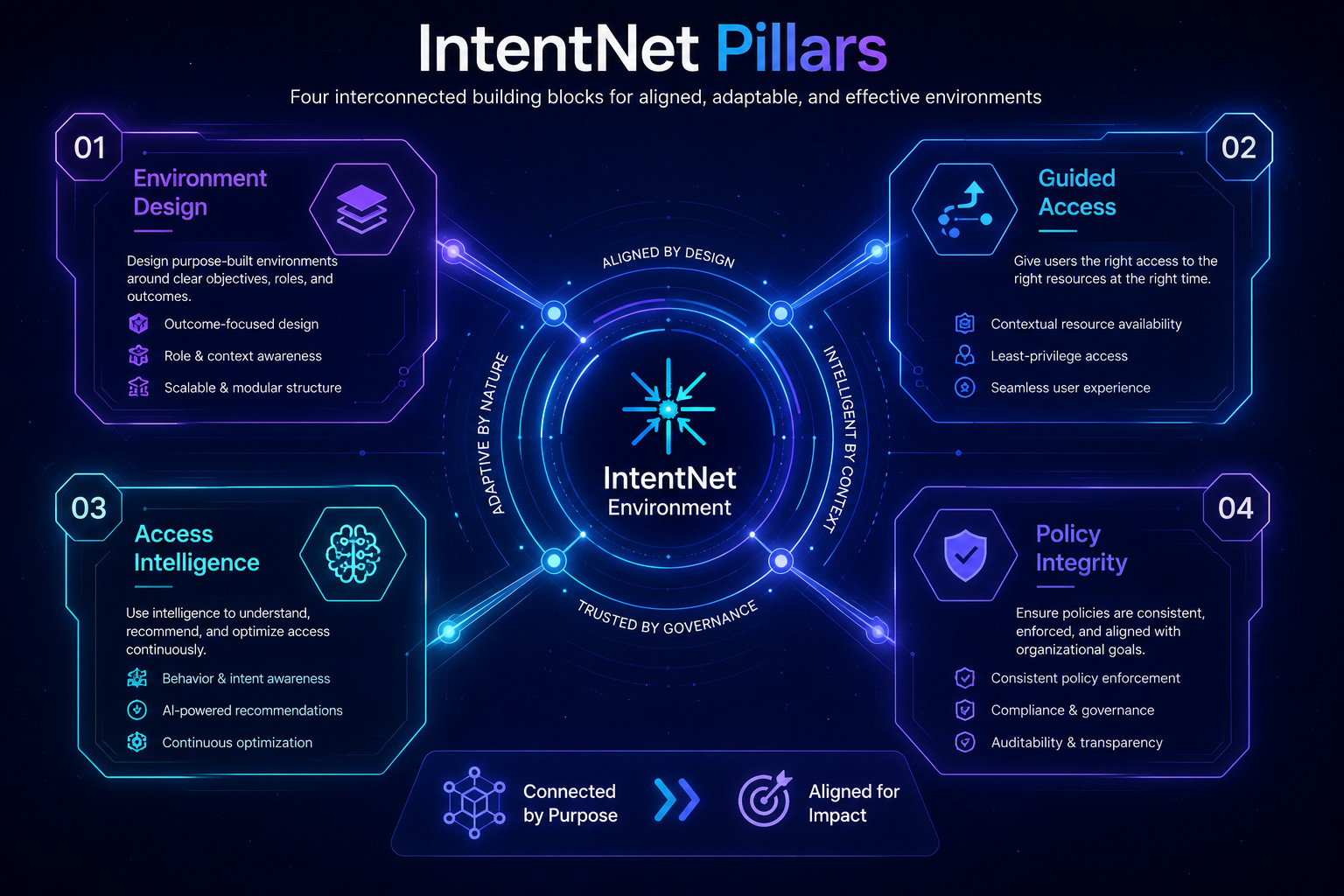
Environment Design
Defines the intended purpose.
Guided Access
Allows controlled evolution.
Access Intelligence
Provides visibility into how environments are changing.
Together they create a governance model capable of adapting without losing direction.
Exceptions Are Not The Enemy
Organizations often accumulate thousands of exceptions.
The presence of exceptions is not necessarily a problem.
The absence of review is.
A temporary approval may remain valid.
A project-specific resource may deserve permanent inclusion.
A previously approved tool may no longer serve the environment.
Policy Integrity encourages periodic re-evaluation.
Not automatic rejection.
Not automatic approval.
Continuous validation.
Policy Integrity As A Feedback Loop
One way to understand Policy Integrity is as a feedback mechanism.

Purpose
↓
Environment
↓
Usage
↓
Observation
↓
Review
↓
Adjustment
↓
Alignment
The cycle repeats continuously.
The objective is preserving coherence over time.
Why This Matters
Organizations invest significant effort designing environments.
The larger challenge is preserving those environments.
Three years after launch.
Five years after launch.
After hundreds of requests.
After thousands of decisions.
After multiple technology shifts.
Policy Integrity asks whether the original objective remains visible.
Because if purpose disappears, the environment eventually becomes directionless.
The Simplest Explanation
Guided Access helps environments evolve.
Access Intelligence helps environments learn.
Policy Integrity helps environments remember why they exist.
Without evolution, environments become obsolete.
Without integrity, environments lose their identity.
Successful environments require both.
Next: What IntentNet Is Not
Many people first encounter IntentNet through familiar categories such as VPNs, firewalls, proxies, or Zero Trust platforms. Next, we'll explore why IntentNet is something different.
Competitive Positioning
IntentNet Is Not a VPN, Firewall, Proxy, or Zero Trust Platform
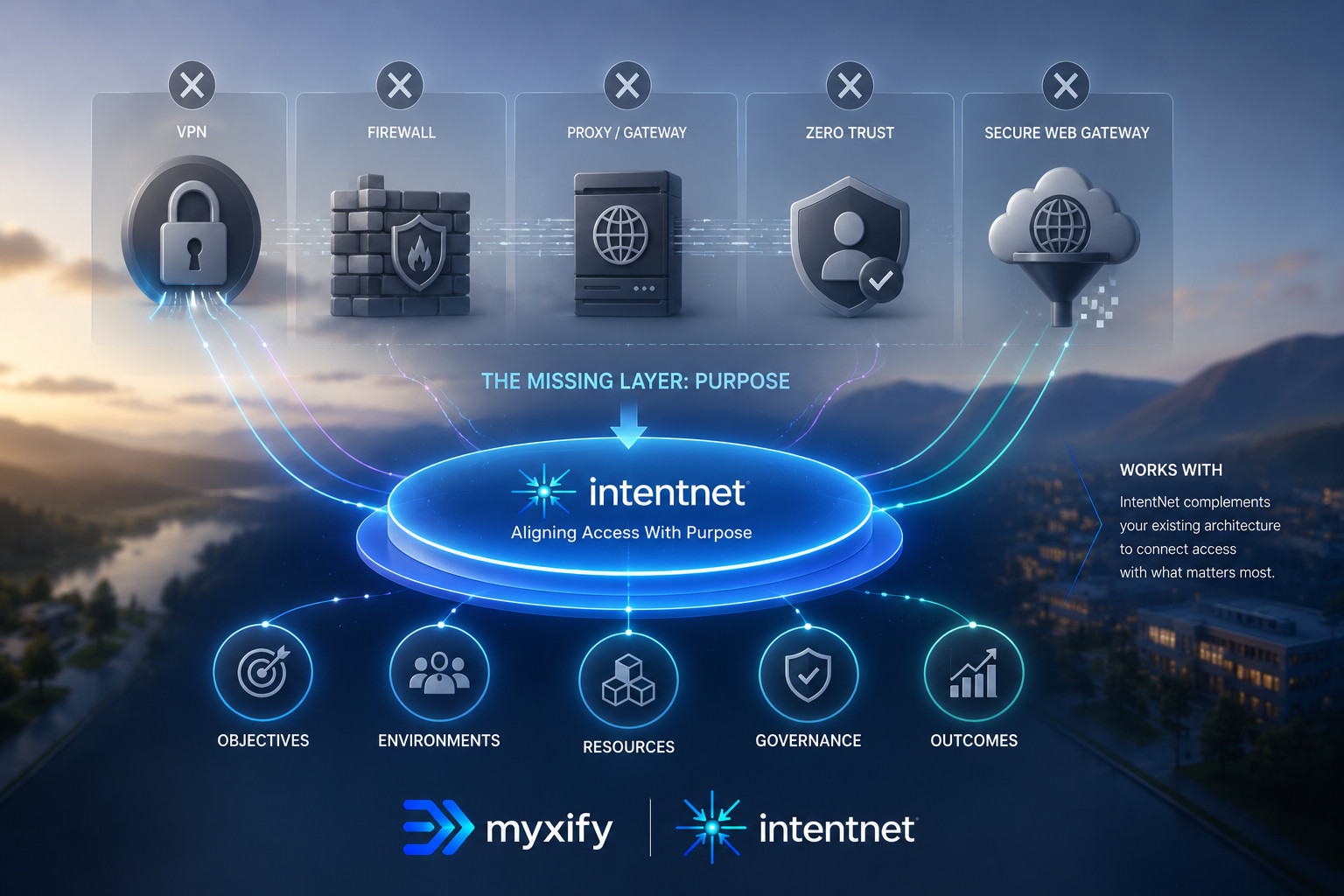
Every new technology is initially compared to something familiar. IntentNet is no exception. Yet IntentNet addresses a different challenge than VPNs, firewalls, proxies, secure gateways, or Zero Trust platforms.
IntentNet Is Not a VPN, Firewall, Proxy, or Zero Trust Platform
Whenever a new idea appears, people naturally compare it to categories they already understand.
That is usually a good thing.
It helps create a starting point.
The challenge is that sometimes a new idea does not fit neatly into existing categories.
IntentNet is one of those cases.
One of the most common questions we hear is:
Is IntentNet a VPN?
Or:
Is it a firewall?
Or a proxy?
Or Zero Trust?
The short answer is no.
The longer answer is more interesting.
Existing Technologies Solve Real Problems
IntentNet does not exist because existing technologies failed.
VPNs solve important connectivity problems.
Firewalls solve important security problems.
Proxies solve important routing and mediation problems.
Secure Web Gateways solve important filtering problems.
Zero Trust architectures solve important identity and trust problems.
Organizations need these technologies.
Many organizations will continue using them for years to come.
IntentNet is not trying to replace them.
IntentNet is not an alternative to these technologies.
It is a layer that helps organize them around purpose.
What A VPN Does
A VPN answers a straightforward question.
How can a user securely connect to a network?
That is an important capability.
But it does not answer:
- Why the user is connecting
- Which resources support their objective
- Which environment they belong to
- How that environment should evolve
A VPN creates connectivity.
IntentNet creates context.
What A Firewall Does
A firewall evaluates traffic.
It allows.
Blocks.
Inspects.
Logs.
Enforces policy.
These capabilities remain essential.
Yet a firewall typically does not decide whether a resource contributes to learning, research, productive work, or organizational outcomes.
Firewalls manage traffic.
IntentNet manages environments.
What A Proxy Does
A proxy sits between users and resources.
It can route traffic.
Filter requests.
Enforce policy.
Provide visibility.
Many IntentNet deployments may include proxies.
But a proxy primarily answers:
How should access occur?
IntentNet asks:
What should this environment help people accomplish?
Those are different questions.
What Zero Trust Does
Zero Trust is one of the most important architectural developments of the last decade.
Its core principle is simple.
Never trust implicitly.
Continuously verify.
Identity matters.
Device posture matters.
Context matters.
Trust becomes dynamic.
These ideas are valuable.
Yet Zero Trust still focuses primarily on trust decisions.
IntentNet focuses on purpose decisions.
The two approaches are complementary.
Not competitive.
The Missing Layer
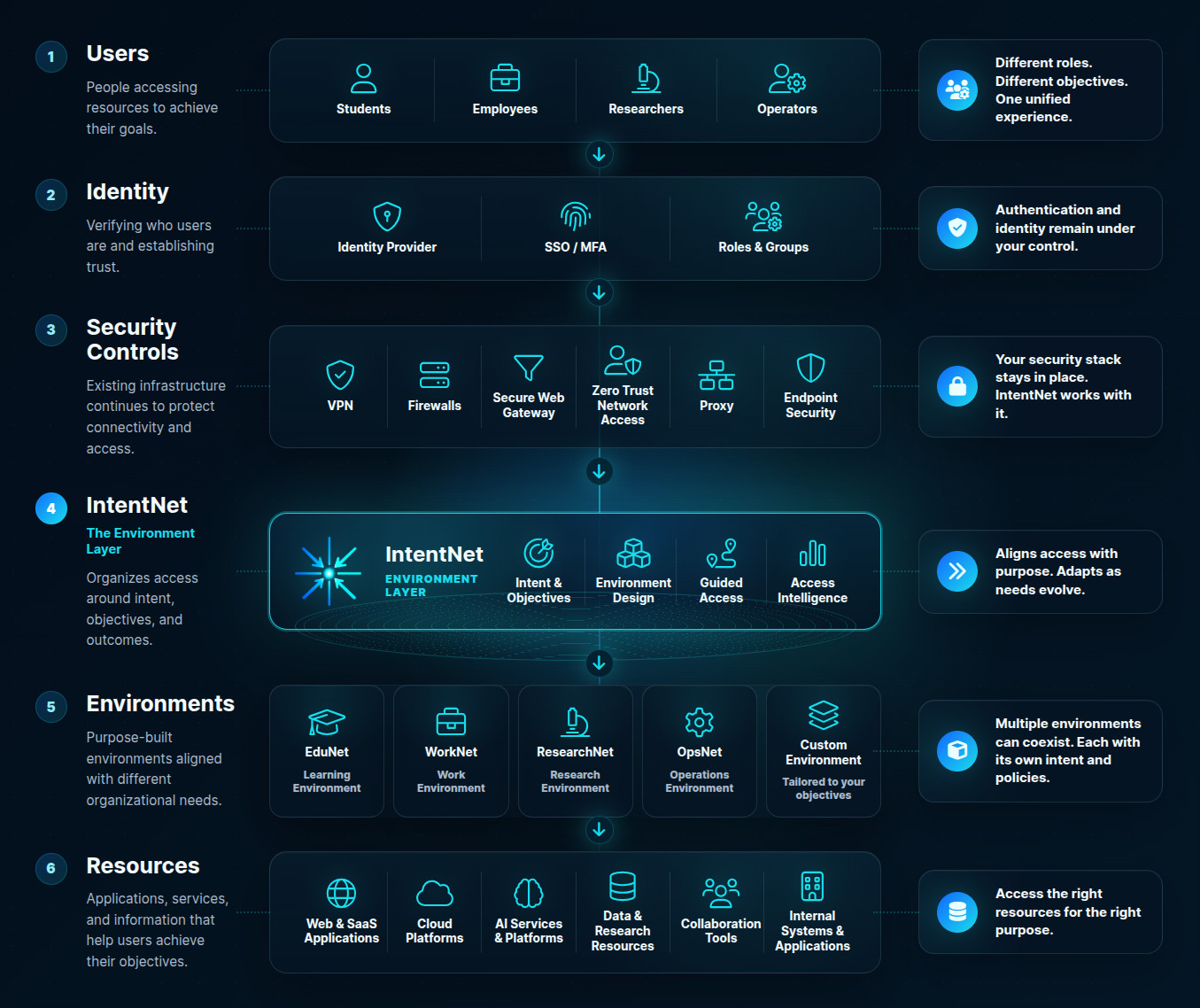
One way to understand IntentNet is to look at the question each technology answers.
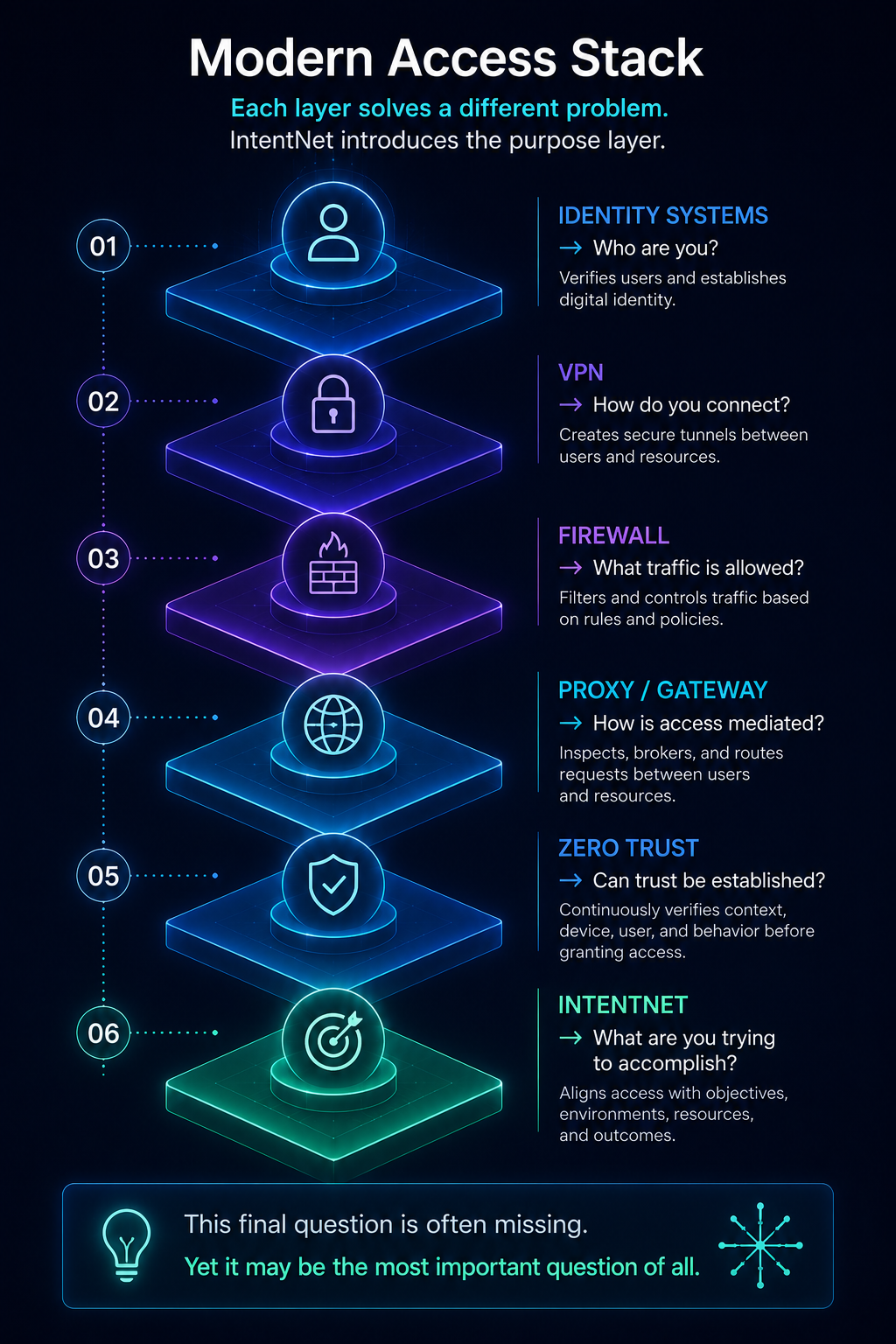
Identity Systems
→ Who are you?
VPN
→ How do you connect?
Firewall
→ What traffic is allowed?
Proxy / Gateway
→ How is access mediated?
Zero Trust
→ Can trust be established?
IntentNet
→ What are you trying to accomplish?
This final question is often missing.
Yet it may be the most important question of all.
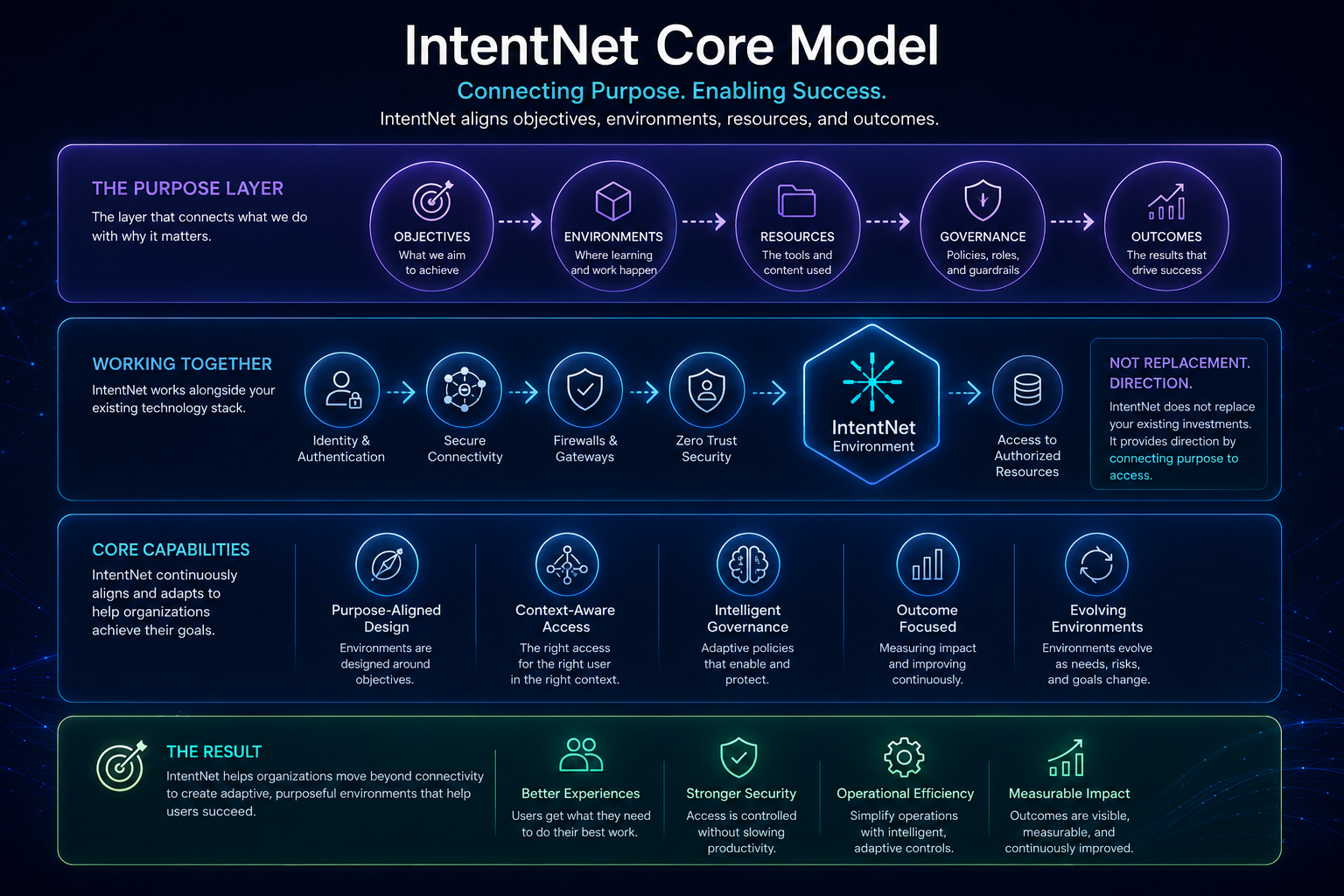
The Purpose Layer
IntentNet introduces a layer above traditional connectivity and security controls.
That layer connects:
- Objectives
- Environments
- Resources
- Governance
- Outcomes
The purpose layer helps organizations move beyond simple connectivity.
The objective is not merely connecting users.
The objective is helping users succeed.
Working Together
In practice, organizations may deploy all of these technologies simultaneously.
A user may:
- Authenticate through identity systems
- Connect through secure infrastructure
- Pass through firewalls and gateways
- Operate within Zero Trust controls
- Access resources through an IntentNet environment
Nothing needs to be replaced.
IntentNet simply provides direction.
It helps answer why the environment exists and how it should evolve.
Why The Distinction Matters
Many organizations already possess strong security controls.
Many already possess strong networking infrastructure.
Many already possess sophisticated governance frameworks.
Yet they still struggle with questions such as:
- Which AI tools belong in the environment?
- Which resources support learning?
- Which platforms support research?
- Which services support productive work?
- How should environments evolve?
Those questions are difficult because they are not primarily connectivity questions.
They are purpose questions.
The Simplest Explanation
VPNs connect.
Firewalls inspect.
Proxies route.
Secure Web Gateways filter.
Zero Trust verifies.
IntentNet aligns.
That is why IntentNet belongs alongside these technologies rather than replacing them.
Next: EduNet
Now that we've established where IntentNet fits, let's explore its first real-world implementation: EduNet, the Education Internet.
EduNet
EduNet: Education Internet for the AI Era
Students need AI tutors, coding platforms, research resources, digital libraries, and collaboration tools. They do not necessarily need the entire internet. EduNet introduces a different approach: Education Internet.

EduNet: Education Internet for the AI Era
For decades educational institutions faced a difficult choice.
Provide unrestricted internet access.
Or restrict access heavily.
Neither option has proven entirely satisfactory.
The open internet contains extraordinary educational opportunities.
It also contains distractions, misinformation, entertainment platforms, commercial services, and countless resources unrelated to learning.
At the same time, heavily restricted environments often prevent students from accessing valuable tools.
Education deserves a better option.
That option is EduNet.
The Internet Was Not Designed For Education
The internet was designed as a general-purpose network.
Its greatest strength is openness.
Anyone can publish.
Anyone can create.
Anyone can participate.
For society this has been enormously valuable.
For educational institutions it creates a challenge.
A learning environment must support learning.
The internet supports everything.
Those are not the same objective.
EduNet does not attempt to replace the internet.
It creates an educational environment within it.
The Modern Learning Environment
Today's students depend on digital resources.
Examples include:
- AI tutors
- Educational AI assistants
- Coding platforms
- Digital libraries
- Research databases
- Learning management systems
- University resources
- Academic journals
- Educational video platforms
- Collaboration tools
These resources are no longer optional.
They are becoming part of the educational foundation itself.
The challenge is providing access to learning resources without turning every learning session into an exercise in distraction management.
Education Internet
EduNet introduces a simple concept.
Education Internet.
Instead of exposing students to the entire internet, institutions create environments centered around educational objectives.
The environment contains resources because they contribute to learning.
Not simply because they are reachable.
Learning
↓
Learning Environment
↓
Learning Resources
↓
Learning Outcomes
The focus shifts from websites to educational purpose.
Learning Resources Instead Of Block Lists
Many educational access models are built around restrictions.
Lists of blocked websites.
Lists of prohibited categories.
Lists of exceptions.
EduNet approaches the problem differently.
Instead of asking:
What should be blocked?
EduNet begins by asking:
What helps students learn?
That change in perspective is important.
The objective is not restriction.
The objective is learning.
AI Changes The Conversation
Artificial intelligence has accelerated educational change.
Students increasingly use:
- AI tutors
- Writing assistants
- Coding assistants
- Research assistants
- Language learning systems
Some institutions respond by attempting to block AI entirely.
Others allow unrestricted use.
Both approaches create challenges.
EduNet allows institutions to define which AI resources belong inside their educational environment and how they should be used.
The conversation becomes educational rather than purely technical.
Students Discover New Resources
No educational environment can predict every future learning resource.
Students often discover valuable tools before institutions do.
This creates an important challenge.
How should environments evolve?
EduNet addresses this through Guided Access.
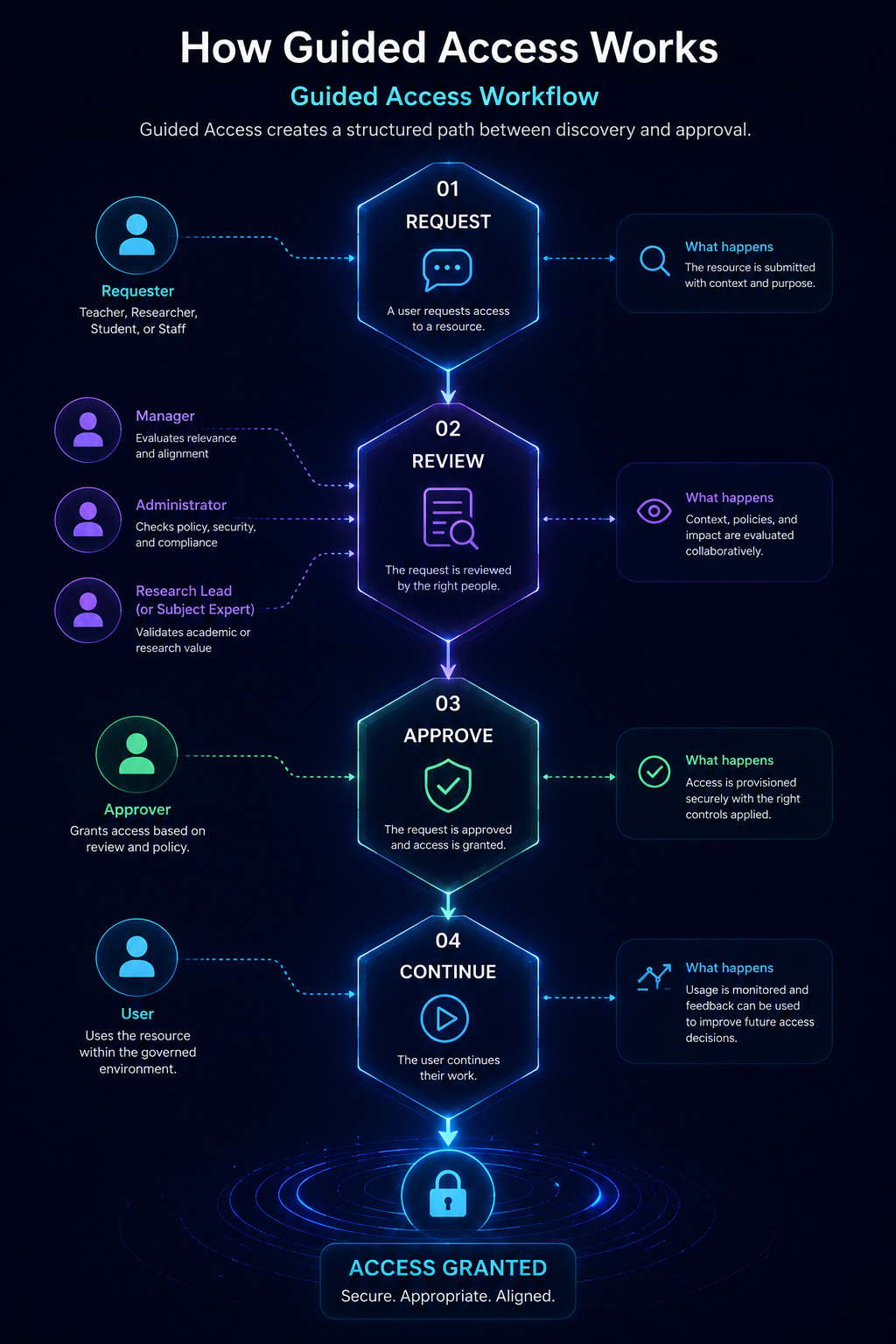
Request
↓
Review
↓
Approve
↓
Continue Learning
Teachers.
Administrators.
Parents.
Educational leaders.
All can participate in the decision process.
The environment remains adaptable without losing direction.
Consistency Matters
One of the most overlooked aspects of educational technology is consistency.
Students benefit when learning environments behave predictably.
Teachers benefit when educational resources are reliable.
Institutions benefit when governance remains understandable.
EduNet creates consistency by aligning resources with educational objectives.
Students spend less time navigating complexity and more time learning.
More Than Filtering
At first glance EduNet may resemble a filtering system.
It is not.
Filtering focuses on destinations.
EduNet focuses on environments.
Filtering asks:
Should this site be blocked?
EduNet asks:
Does this resource support learning?
That distinction changes how educational environments are designed.
Why EduNet Matters
The future of education will be increasingly digital.
Students will learn through AI.
Research will become more connected.
Learning resources will continue expanding.
Educational institutions need a model that supports these changes without abandoning educational objectives.
EduNet was created for that purpose.
The One-Sentence Test
If a student needs AI tutors, coding platforms, research resources, educational video, academic databases, and collaboration tools, but does not need the entire internet, then EduNet may be the right model.
That is Education Internet.
Next: WorkNet
Education is only one example of a purpose-built environment. Next, explore how the same foundation applies to modern organizations through WorkNet.
WorkNet
WorkNet: Work Internet for Modern Teams
Modern organizations depend on SaaS platforms, cloud services, AI assistants, contractors, and distributed teams. WorkNet creates environments designed around productive work rather than unrestricted internet access.

AI Governance Belongs Inside the Environment
Artificial intelligence has become one of the fastest-adopted technologies in modern history.
Within just a few years, AI systems moved from research laboratories into classrooms, offices, development environments, customer support operations, research institutions, and executive workflows. Employees use AI assistants to draft reports, analyze data, write software, summarize information, and automate routine tasks. Students increasingly rely on AI tutors, writing assistants, coding companions, and personalized learning tools.
For most organizations, the question is no longer whether AI will be used.
The question is how AI can be adopted responsibly while preserving organizational objectives, governance requirements, privacy expectations, and operational integrity.
That challenge has given rise to an entirely new discipline: AI governance.
Yet many organizations are approaching governance in ways that are unlikely to succeed.
They treat governance as a separate process rather than an integrated part of the environment where AI is actually used.
We believe the most effective AI governance emerges when governance is embedded directly into the environments where people learn, work, research, and collaborate.
AI governance is most effective when it becomes part of everyday operations rather than a separate compliance exercise.
The First Wave Of AI Governance
When organizations first encountered generative AI, many responded with uncertainty.
The pace of change was extraordinary.
New models appeared every few months.
New AI applications emerged every week.
Employees often discovered new tools long before formal governance processes could evaluate them.
Faced with this uncertainty, organizations typically adopted one of two approaches.
The first approach was prohibition.
Block AI systems.
Restrict access.
Delay adoption until policies could be developed.
The second approach was unrestricted experimentation.
Allow employees to choose whichever tools they preferred and trust individual judgment to manage the associated risks.
Neither approach proved sustainable.
Excessive restriction limited innovation and often encouraged employees to find workarounds. Unrestricted adoption created concerns about data protection, compliance, intellectual property, consistency, and accountability.
Organizations quickly discovered that AI governance required a more nuanced approach.
Policies Alone Do Not Create Governance
Many governance initiatives begin with documentation.
Organizations write policies.
Create guidelines.
Define acceptable use requirements.
Establish approval processes.
These efforts are valuable.
Policies provide direction.
They establish expectations.
They clarify responsibilities.
However, policies alone rarely determine day-to-day behavior.
Eventually employees need practical answers to practical questions.
- Which AI tools are approved?
- Which models can process sensitive information?
- Which workflows are recommended?
- Which use cases require additional review?
- How should new tools be evaluated?
- Who approves exceptions?
These decisions occur inside operational environments.
Governance therefore becomes most effective when those environments themselves communicate and enforce governance principles.
Governance Must Become Operational
Successful governance is not merely documented.
It is operationalized.
People should not need to consult a lengthy policy document every time they encounter a new AI capability.
Instead, governance should be reflected directly in the environment they use every day.
The environment should clearly indicate:
- Approved AI resources
- Available workflows
- Permitted use cases
- Review processes
- Escalation paths
- Responsible usage expectations
When governance becomes part of the environment, compliance becomes easier because responsible behavior becomes the default behavior.
This principle has been widely adopted in cybersecurity, safety engineering, and organizational design. AI governance is increasingly following the same path.
Different Objectives Require Different AI Environments
One of the most common governance mistakes is assuming that all AI use cases should be governed in the same way.
In reality, governance requirements differ significantly depending on the environment.
A university has different objectives than a software company.
A research institution has different objectives than a public-sector agency.
A healthcare organization operates under different constraints than a marketing team.
As a result, the governance model should reflect the purpose of the environment.
Learning Environment
→ Educational AI
Research Environment
→ Discovery AI
Work Environment
→ Productivity AI
Operational Environment
→ Process AI
Purpose provides context.
Context enables better governance decisions.
EduNet And Educational AI Governance
Educational institutions face a unique challenge.
AI is rapidly becoming part of the learning process itself.
Students use AI for tutoring, coding assistance, language learning, writing support, research guidance, and problem-solving.
Attempting to eliminate AI from education entirely is becoming increasingly unrealistic.
The more meaningful question is how AI should participate in learning.
Educational leaders must consider issues such as academic integrity, skill development, assessment methods, transparency, and responsible AI use.
EduNet allows institutions to define learning environments that include approved educational AI resources while preserving institutional governance.
Students gain access to valuable tools.
Institutions maintain oversight.
The objective remains learning.
WorkNet And Enterprise AI Governance
Organizations face a different set of challenges.
Employees frequently discover and adopt AI tools before governance teams have completed formal evaluations.
This creates several familiar risks.
- Shadow AI
- Data leakage concerns
- Regulatory uncertainty
- Inconsistent workflows
- Unapproved automation
- Fragmented adoption patterns
Many organizations attempt to address these risks through restrictions alone.
However, employees often adopt AI because it helps them work more effectively.
A governance model that ignores this reality is unlikely to succeed.
WorkNet addresses this challenge by creating environments where approved AI capabilities, governance controls, and productivity objectives coexist.
The goal is not to stop innovation.
The goal is to guide it.
Governance Requires A Process For Change
One of the defining characteristics of AI is the speed at which it evolves.
New models appear continuously.
New capabilities emerge unexpectedly.
New vendors enter the market.
No organization can realistically pre-approve every future AI system.
This is why governance must include a mechanism for controlled evolution.
IntentNet approaches this challenge through Guided Access.
Rather than forcing organizations into a binary choice between unrestricted adoption and permanent restriction, Guided Access creates a structured process for evaluating emerging tools.
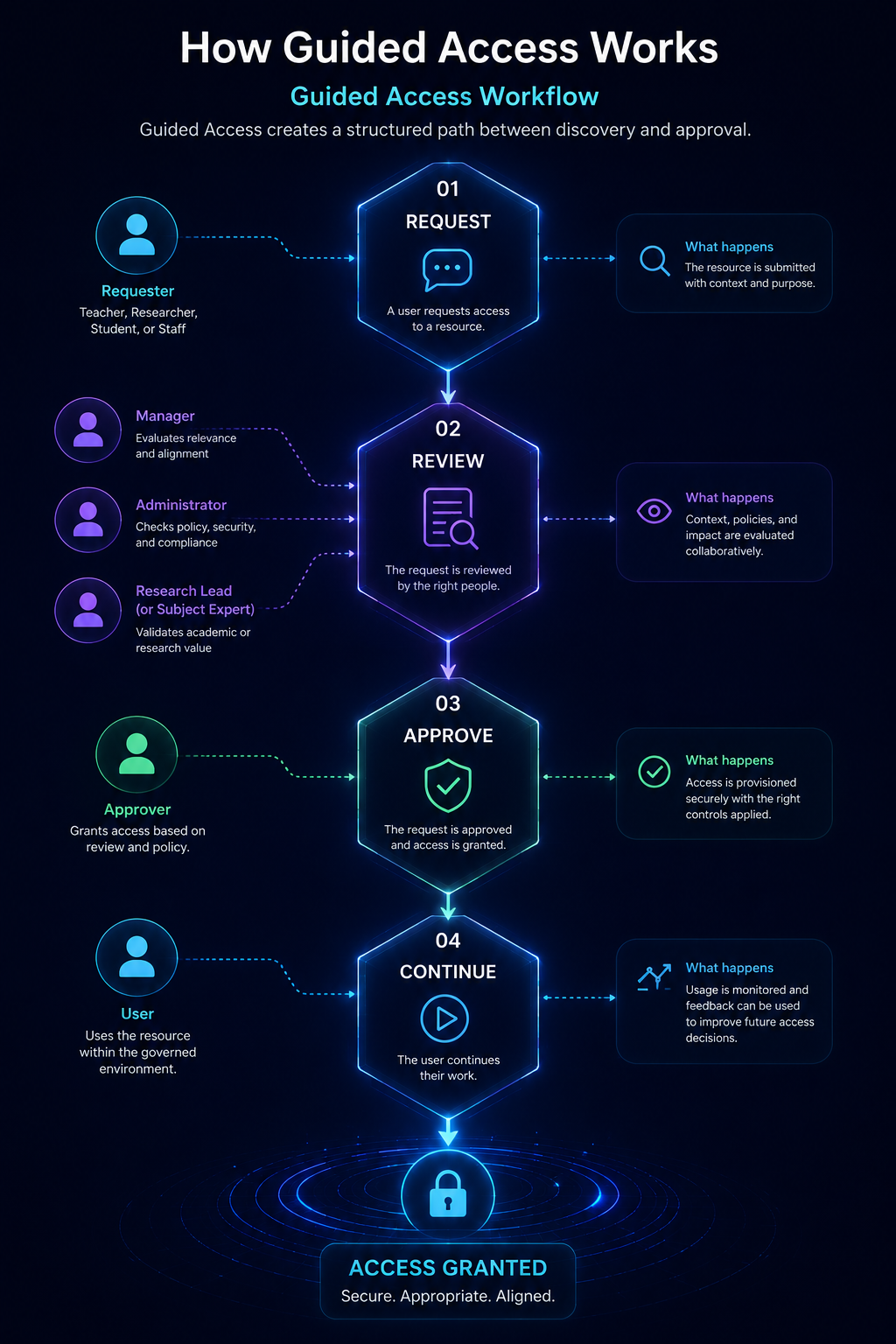
Request
↓
Review
↓
Approve
↓
Continue
This allows organizations to adapt without sacrificing accountability.
Governance Requires Learning
Strong governance is not static.
It improves over time.
Organizations learn from adoption patterns, requests, emerging technologies, operational outcomes, and user needs.
This is where Access Intelligence becomes particularly valuable.
Organizations should understand:
- Which AI tools create value
- Which resources are repeatedly requested
- Which policies create friction
- Which governance decisions require review
- Which capabilities are becoming strategically important
The purpose of this visibility is understanding.
Not surveillance.
Governance improves when organizations learn from real-world usage rather than relying solely on assumptions.
The Future Of AI Governance
Much of the public conversation around AI governance focuses on controls.
Controls matter.
Policies matter.
Compliance matters.
However, governance ultimately exists to enable responsible capability.
Organizations that succeed with AI will not be those that prohibit everything.
Nor will they be those that permit everything.
They will be organizations that create environments where innovation, accountability, transparency, and adaptability reinforce one another.
In other words, they will build environments where governance is not an obstacle to progress.
It becomes part of how progress occurs.
The Simplest Explanation
AI governance works best when it is embedded directly into the environments where people learn, work, research, and collaborate.
Approved tools.
Clear processes.
Defined responsibilities.
Guided evolution.
Continuous learning.
Responsible adoption.
That is why AI governance belongs inside the environment.
Next: Beyond EduNet And WorkNet
Education and work are only the beginning. Explore how IntentNet can support research environments, AI ecosystems, public services, regulated industries, and entirely new categories of purpose-built digital environments.
AI Governance
AI Governance Belongs Inside the Environment
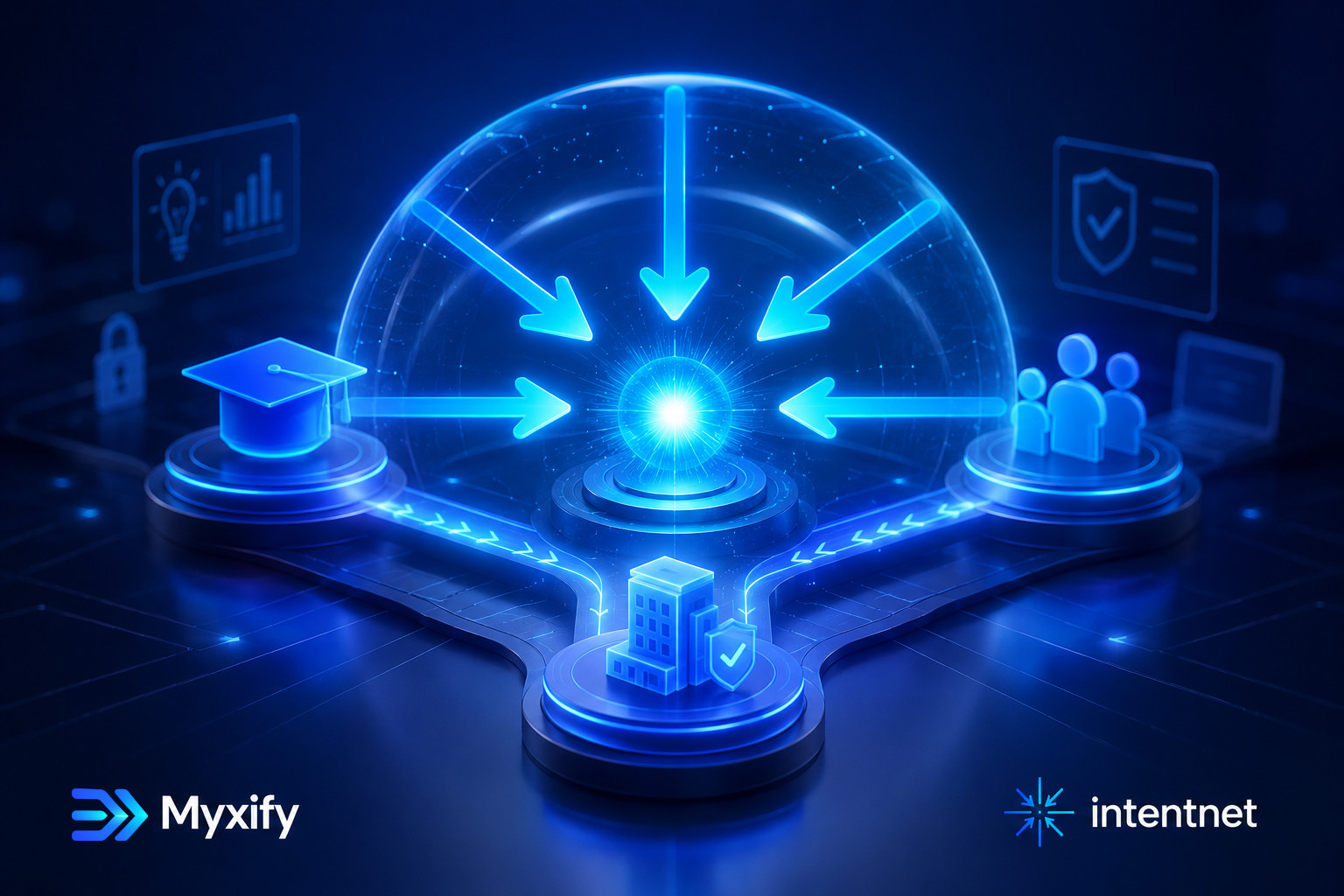
Organizations increasingly recognize that AI governance is not a separate compliance exercise. The most effective governance emerges when approved tools, workflows, policies, and oversight are embedded directly into the environments where people work and learn.
AI Governance Belongs Inside the Environment
Artificial intelligence has become one of the fastest-adopted technologies in modern history.
Students use AI tutors.
Researchers use AI assistants.
Developers use AI coding tools.
Knowledge workers use AI to draft, summarize, analyze, and collaborate.
The question is no longer whether organizations will use AI.
The question is how they will use it responsibly.
That is where governance becomes important.
The False Choice
Many organizations initially respond to AI in one of two ways.
The first approach is prohibition.
Block everything.
Disallow AI entirely.
Prevent experimentation.
The second approach is unrestricted adoption.
Allow every tool.
Allow every model.
Allow every workflow.
Trust individuals to navigate the risks.
Neither approach scales well.
One limits innovation.
The other creates uncertainty.
The goal of AI governance is not stopping AI.
The goal is enabling AI responsibly.
Policies Alone Are Not Enough
Many organizations begin their governance journey by writing policies.
Policies are important.
They establish expectations.
They clarify responsibilities.
They define acceptable behavior.
But policies do not create operating environments.
Employees eventually need practical answers.
Questions such as:
- Which AI tools are approved?
- Which models can access company information?
- Which workflows are acceptable?
- How are new tools evaluated?
- Who approves exceptions?
These questions cannot be answered by policy documents alone.
They require operational environments.
Governance Must Be Operational
Effective governance works best when it becomes part of everyday activity.
People should not need to leave their environment to understand governance.
The environment itself should communicate:
- Which tools are approved
- Which resources are available
- Which workflows are supported
- Which requests require review
Governance becomes part of the experience.
Not a separate layer of bureaucracy.
AI Environments Are Different
One of the most common mistakes organizations make is assuming that all AI usage is the same.
It is not.
A school has different objectives than a research institution.
A research institution has different objectives than a software company.
A software company has different objectives than a government agency.
Different objectives require different environments.
Learning Environment
→ Educational AI
Research Environment
→ Discovery AI
Work Environment
→ Productivity AI
Operational Environment
→ Process AI
Governance should reflect purpose.
EduNet And AI Governance
Educational institutions face unique challenges.
Students increasingly rely on AI for:
- Learning support
- Writing assistance
- Coding help
- Research guidance
- Language learning
Attempting to eliminate AI from education is increasingly unrealistic.
The more practical challenge is determining how AI should participate in learning.
EduNet allows institutions to define educational AI environments aligned with their goals.
WorkNet And AI Governance
Organizations face a different challenge.
Employees often discover new AI tools before governance frameworks catch up.
This creates:
- Shadow AI
- Data exposure concerns
- Compliance questions
- Inconsistent workflows
- Fragmented adoption
WorkNet allows organizations to define approved AI environments while preserving flexibility.
Innovation continues.
Governance remains intact.
Guided Access Supports Innovation
One reason AI governance becomes difficult is the speed of change.
New tools appear constantly.
No organization can pre-approve every future system.
IntentNet addresses this through Guided Access.
Request
↓
Review
↓
Approve
↓
Continue
This allows experimentation without abandoning governance.
Governance Requires Learning
Good governance evolves.
Organizations learn from:
- Adoption patterns
- Resource requests
- Emerging tools
- User behavior
- Operational outcomes
This is where Access Intelligence becomes valuable.
Governance improves when organizations understand what is happening inside their environments.
The objective is insight.
Not surveillance.
The Future Of AI Governance
Many governance discussions focus on controls.
Controls matter.
But governance is ultimately about enabling responsible capability.
Organizations that succeed with AI will not be the ones that block everything.
Nor will they be the ones that allow everything.
They will be the organizations that create environments where innovation and accountability coexist.
The Simplest Explanation
AI governance works best when it is embedded inside the environment itself.
Approved tools.
Clear workflows.
Defined responsibilities.
Guided evolution.
Continuous learning.
That is why AI governance belongs inside the environment.
Final Article: The Future Of Purpose-Built Internet
We've explored IntentNet, EduNet, WorkNet, governance, intelligence, and environments. The final article looks ahead at where purpose-built digital environments may lead next.
READING JOURNEY
Continue Reading
IntentNet Is Not a VPN, Firewall, Proxy, or Zero Trust Platform
Continue ReadingRELATED ARTICLES
Keep exploring the knowledge hub.
 Access Intelligence
Access Intelligence Without Surveillance
Organizations need visibility. Users need privacy. The challenge is obtaining meaningful operational insight without turning digital environments into surveillance systems.
Competitive PositioningIntentNet Is Not a VPN, Firewall, Proxy, or Zero Trust Platform
Every new technology is initially compared to something familiar. IntentNet is no exception. Yet IntentNet addresses a different challenge than VPNs, firewalls, proxies, secure gateways, or Zero Trust platforms.
 Guided Access
Guided Access: Guide Instead of Block
For decades digital access systems relied on two answers: yes or no. IntentNet introduces a third answer: not yet. Guided Access helps environments evolve without becoming unrestricted.